Tag: Cat Products

  • New Cat Essentials You Should Not Waste Money On

    New Cat Essentials You Should Not Waste Money On

    Affiliate disclosure: This article contains Amazon affiliate links. As an Amazon Associate, Cat Costs UK earns from qualifying purchases.

    It is easy to overspend when getting a new cat. Shops and online guides can make everything feel essential, but many products are optional, can wait, or are only worth buying once you know your cat’s habits.

    New cat essentials: quick answer

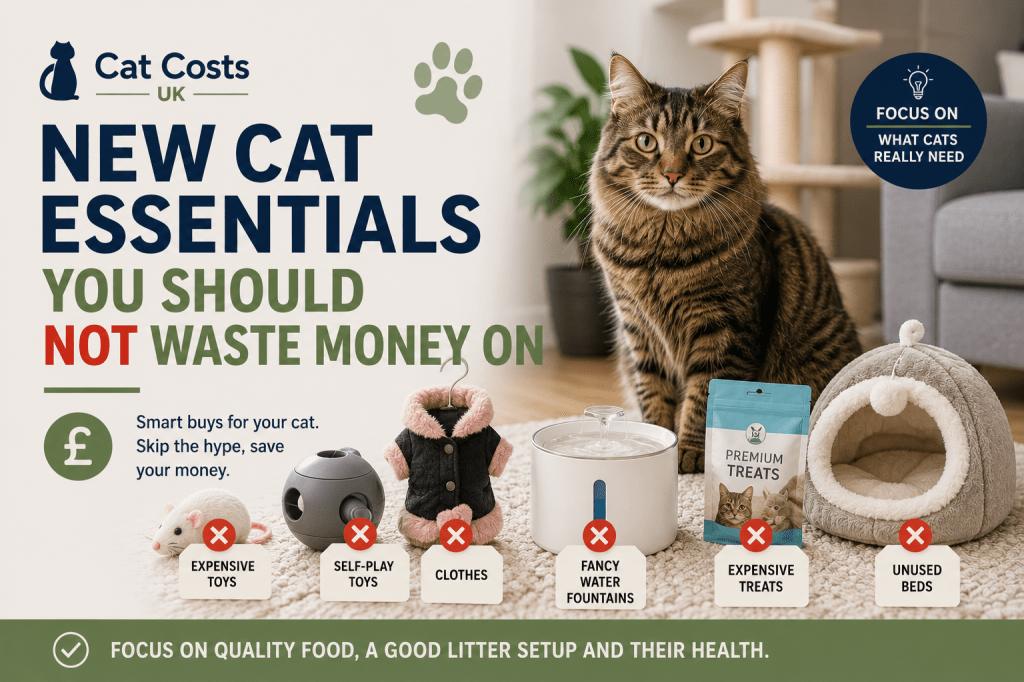
    The essentials for most new cats are food, bowls, litter, a litter tray, a secure carrier, a scratching option, a simple bed or blanket, and a few toys. Expensive extras like fountains, automatic feeders, cat cameras, backpacks and large cat trees can wait until you know what your cat actually uses.

    What to buy first

    PriorityProductWhy it mattersCompare options
    EssentialCat carrierNeeded for collection, vet trips and emergencies.Compare cat carriers
    EssentialLitter tray and scoopOne of the first things your cat will need at home.Compare litter trays
    EssentialFood and water bowlsSimple bowls are enough to start with.Compare cat bowls
    UsefulScratching postGives your cat somewhere acceptable to scratch.Compare scratching posts

    Products you probably do not need straight away

    These products can be useful, but they are not always day-one essentials. Waiting can save money because you will understand your cat’s personality, space needs and routine first.

    1. Expensive cat trees

    A cat tree can be a great purchase, but you do not need to buy the biggest one immediately. Start with a scratching post or smaller tree, then upgrade if your cat enjoys climbing and you have the space.

    Compare starter scratching posts on Amazon or compare cat trees.

    2. Automatic feeders

    Automatic feeders are handy for routines, but a normal bowl is usually fine when your cat first arrives. Consider one later if you need timed meals or you are often out at feeding times.

    Compare automatic cat feeders on Amazon.

    3. Cat water fountains

    Some cats drink more happily from fountains, but not all cats use them. Start with simple water bowls and only upgrade if your cat ignores still water or seems to prefer running water.

    Compare cat water fountains on Amazon.

    4. Cat cameras and GPS trackers

    These can be useful for peace of mind, but they are optional. A camera may suit indoor cats when you are out, while a GPS tracker is mainly relevant for cats that go outside.

    Compare cat cameras or compare GPS cat trackers.

    5. Cat backpacks

    A cat backpack can look appealing, but a secure carrier is usually the better first buy. Consider a backpack only if your cat is calm, the design is well ventilated and it fits your actual travel plans.

    Compare cat backpacks on Amazon.

    Where spending more can make sense

    • Cat carrier: worth choosing carefully because it affects vet trips and travel.
    • Litter tray: size and access matter more than fancy design.
    • Scratching post: a stable post may protect furniture better than a cheap wobbly one.
    • Food storage: useful if you buy larger bags of dry food.
    • Insurance or vet costs: budget for care rather than spending everything on accessories.

    My recommendation

    Buy the basics first, then upgrade based on your cat’s behaviour. The biggest waste usually comes from buying premium products before you know whether your cat will use them.

    Related guides

    FAQs

    What do I actually need for a new cat?

    Most new cats need food, bowls, litter, a litter tray, a carrier, a scratching option, somewhere to sleep and a few simple toys.

    Are cat fountains and automatic feeders essential?

    No. They can be useful later, but most new cat owners can start with normal bowls and upgrade only if there is a clear need.

    Should I buy a cat tree straight away?

    A small cat tree or scratching post is sensible, but a large premium cat tree can wait until you know whether your cat enjoys climbing.

    Last updated: 2 July 2026
  • Are Cat Water Fountains Worth It?

    Are Cat Water Fountains Worth It?

    Affiliate disclosure: This article contains Amazon affiliate links. As an Amazon Associate, Cat Costs UK earns from qualifying purchases.

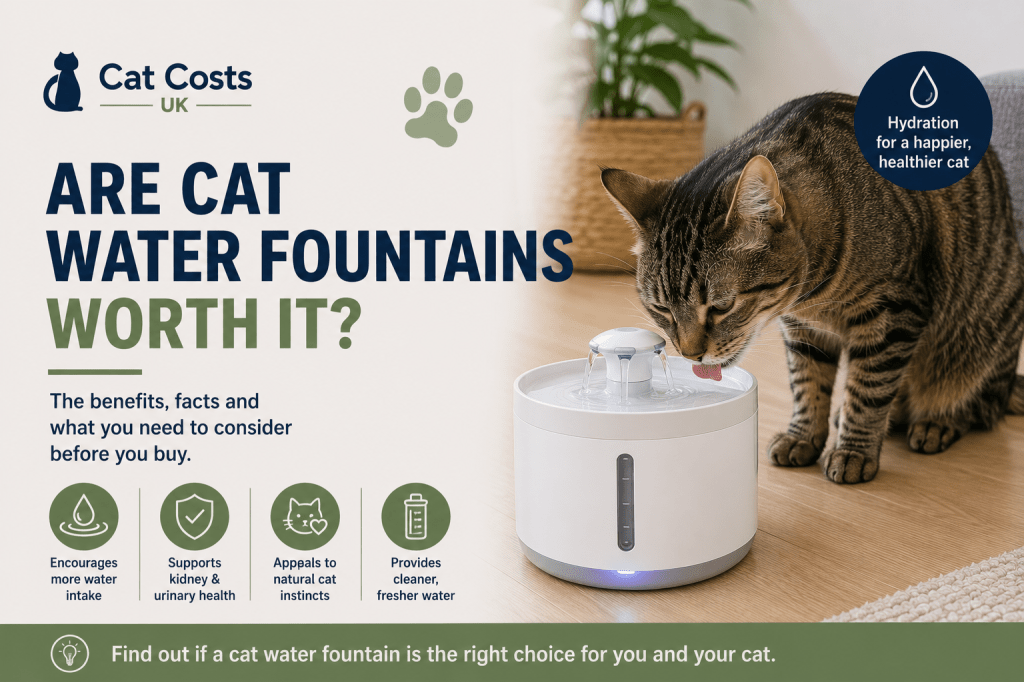
    Cat water fountains are popular because many cats seem interested in moving water. They can be useful, but they are not essential for every cat. The right answer depends on your cat’s drinking habits, your cleaning routine and whether you are happy to replace filters.

    Are cat water fountains worth it? Quick answer

    A cat water fountain can be worth it if your cat prefers running water, ignores normal bowls, or you want to encourage more interest in drinking. A normal water bowl is usually enough if your cat already drinks well and you change the water regularly.

    When a cat water fountain is worth buying

    • Your cat is interested in taps or running water.
    • Your cat ignores still water bowls.
    • You want a larger water capacity than a small bowl.
    • You are happy to clean the fountain regularly.
    • You are comfortable buying replacement filters.

    When a normal bowl is enough

    A normal water bowl is enough for many cats. If your cat already drinks from bowls, you change water daily and the bowl is placed away from food and litter, you may not need a fountain at all.

    Compare cat water bowls on Amazon.

    Best fountain features to check

    FeatureWhy it mattersCompare options
    Easy cleaningFountains need regular cleaning to stay fresh.Easy-clean fountains
    Replacement filtersFilter cost affects long-term value.Replacement filters
    Quiet pumpNoisy pumps may put nervous cats off.Quiet fountains
    MaterialStainless steel or ceramic may be easier to clean than some plastic designs.Stainless steel fountains

    Hidden costs to consider

    The fountain itself is not the only cost. You may also need replacement filters, occasional pump replacements and extra cleaning time. If you want a low-effort option, a simple bowl may be easier.

    What to check before buying

    • Cleaning: check how easily the fountain comes apart.
    • Filters: check availability and replacement cost.
    • Pump noise: nervous cats may avoid noisy fountains.
    • Capacity: useful if you have more than one cat.
    • Material: consider stainless steel, ceramic or plastic based on cleaning preference.
    • Cable safety: consider placement if your cat chews.

    My recommendation

    Try a fountain if your cat likes running water or avoids normal bowls. Otherwise, start with a good water bowl and place it somewhere your cat actually likes drinking.

    Related guides

    FAQs

    Do cats prefer water fountains?

    Some cats prefer moving water, but not all cats do. It depends on the individual cat.

    Are cat water fountains expensive to run?

    The main extra costs are usually replacement filters and occasional parts, rather than electricity. Check filter prices before buying.

    Do cat fountains need cleaning?

    Yes. Cat fountains need regular cleaning and filter changes. If you want the lowest-effort option, a normal bowl may be simpler.

    Last updated: 2 July 2026

  • Automatic Feeder vs Normal Bowl for Cats

    Automatic Feeder vs Normal Bowl for Cats

    Affiliate disclosure: This article contains Amazon affiliate links. As an Amazon Associate, Cat Costs UK earns from qualifying purchases.

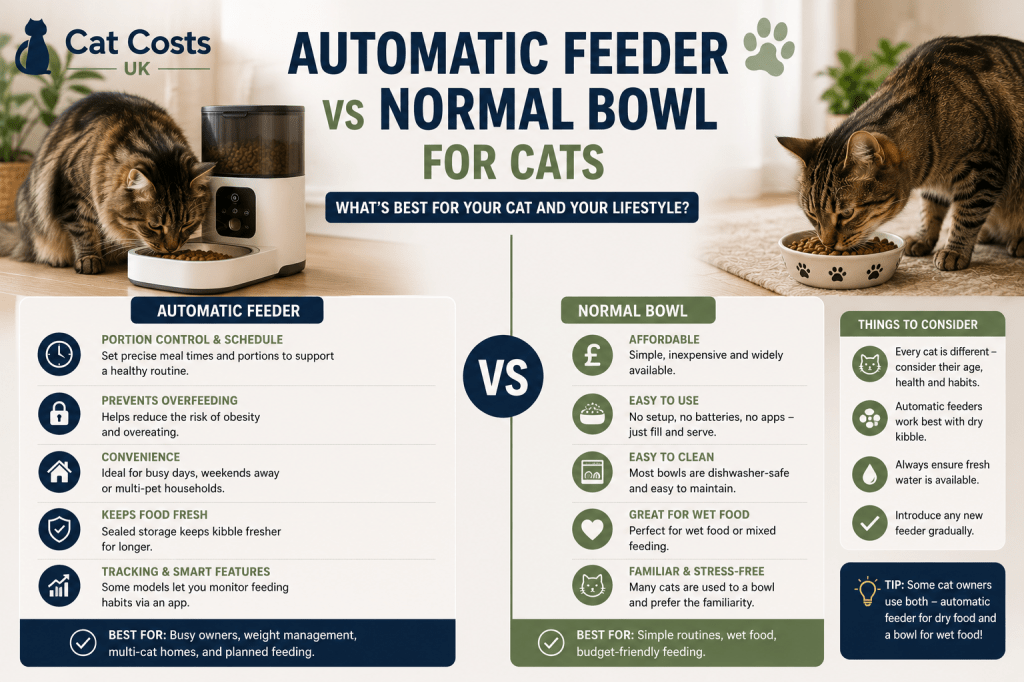
    An automatic cat feeder can make feeding more convenient, but it is not automatically better than a normal bowl. The best choice depends on your routine, whether your cat eats dry or wet food, and whether you need portion control or timed meals.

    Automatic feeder vs normal bowl: quick answer

    A normal bowl is enough for many cats and is the cheapest, simplest option. An automatic feeder is worth considering if you need timed meals, portion control, early-morning feeding support or more consistency when you are out.

    Quick comparison

    OptionBest forWatch out forCompare
    Normal bowlSimple feeding, wet food, low costNo timing or portion automationCompare bowls
    Automatic feederTimed dry food meals and routineHigher upfront cost and cleaningCompare feeders
    Microchip feederMulti-cat homes and food stealingUsually more expensiveCompare microchip feeders
    Slow feeder bowlCats that eat too quicklyNot suitable for every catCompare slow feeder bowls

    When a normal bowl is best

    A normal bowl is best if you are usually home for feeding times, your cat eats wet food, or you want the simplest and cheapest setup. It is also easier to clean and easier to replace.

    Compare cat food bowls on Amazon.

    When an automatic feeder is worth it

    An automatic feeder is worth it if your cat needs a more consistent routine, wakes you early for breakfast, eats dry food, or you want measured meals while you are out. It can also help if you want to split food into smaller meals across the day.

    Compare automatic dry food feeders on Amazon.

    What about wet food?

    Wet food needs more care than dry food. Some timed feeders are designed for wet food, but you should check cleaning, freshness, ice pack options and how long food will sit out. For many cats, a normal bowl is still simpler for wet food.

    Compare automatic wet food feeders on Amazon.

    What to check before buying an automatic feeder

    • Food type: many feeders are mainly for dry food.
    • Portion size: check whether portions suit your cat.
    • Cleaning: removable bowls and food containers are useful.
    • Power: check battery backup or mains power.
    • Noise: some cats dislike feeder sounds.
    • Reliability: read recent customer feedback before buying.
    • Multi-cat homes: consider microchip feeders if food stealing is the issue.

    My recommendation

    Use a normal bowl unless you have a clear reason to upgrade. Choose an automatic feeder for timed dry food meals, and a microchip feeder if the real issue is one cat stealing another cat’s food.

    Related guides

    FAQs

    Are automatic feeders better than bowls?

    Not always. Bowls are cheaper and simpler, while automatic feeders are better for timed meals and routine.

    Can automatic feeders be used for wet food?

    Some can, but you need to check the product is designed for wet food and that it keeps food fresh enough for your routine.

    Are automatic feeders good for cats that overeat?

    They may help with portion control, but speak to a vet if your cat’s weight, appetite or eating behaviour is a concern.

    Last updated: 2 July 2026

  • Best Products for Indoor Cats UK

    Best Products for Indoor Cats UK

    Affiliate disclosure: This article contains Amazon affiliate links. As an Amazon Associate, Cat Costs UK earns from qualifying purchases.

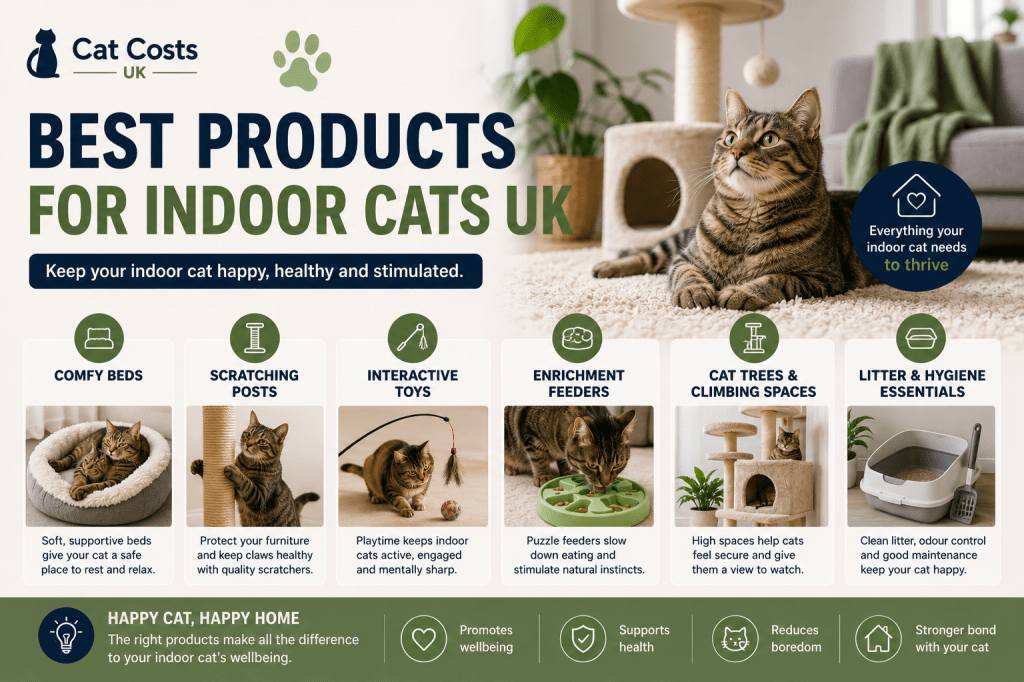
    Indoor cats often need more help with enrichment, climbing, scratching and routine than cats that spend time outdoors. The best products are not always the most expensive; they are the ones that solve a real need in your home.

    Best products for indoor cats UK: quick answer

    For most indoor cats, the best products to prioritise are a sturdy scratching post, a cat tree or window perch, interactive toys, a good litter tray setup, food and water bowls, and simple enrichment toys. Higher-cost products like exercise wheels, cameras and automatic feeders can wait until you know your cat’s routine.

    Quick picks: indoor cat products

    NeedProduct typeWhy it helpsCompare options
    ScratchingScratching postProtects furniture and supports normal scratching.Compare scratching posts
    ClimbingCat tree or shelvesAdds vertical space indoors.Compare cat trees
    Watching outsideWindow perchCreates a comfortable lookout spot.Compare window perches
    EnrichmentPuzzle toysAdds activity and interest to indoor routines.Compare puzzle toys
    Litter controlLitter matHelps reduce tracked litter around the tray.Compare litter mats

    Best for scratching: scratching posts

    A scratching post is one of the most useful indoor cat products. Choose something tall and stable enough for your cat to stretch, rather than a small post that wobbles or tips over.

    Compare tall cat scratching posts on Amazon.

    Best for climbing: cat trees and wall shelves

    Indoor cats benefit from vertical space. A cat tree is the easiest option because it does not need drilling. Wall shelves can work well too, but only if they can be installed securely.

    Compare cat trees for indoor cats on Amazon.

    Best for enrichment: toys and puzzles

    Interactive toys, tunnels, puzzle toys and lick mats can all help break up the day. Rotate toys rather than leaving everything out at once, as many cats lose interest when the same toys are always available.

    Compare cat enrichment toys on Amazon.

    Best for litter control: tray setup and mats

    Indoor cats rely fully on their litter setup, so it is worth getting this right. A suitable tray, scoop, mat and litter storage can make day-to-day cleaning easier and reduce mess around the house.

    Compare cat litter mats on Amazon.

    Higher-cost products to consider later

    • Exercise wheels: useful for some active cats, but expensive and not every cat will use them.
    • Cat cameras: useful for checking in while you are out, but optional.
    • Automatic feeders: helpful for routine, but not essential for every indoor cat.
    • Cat shelves: great for vertical space, but need secure installation.
    • Water fountains: useful for some cats, but bowls are enough for many homes.

    My recommendation

    Start with scratching, climbing, litter control and simple enrichment. Add premium products later only if they solve a clear problem or match your cat’s behaviour.

    Related guides

    FAQs

    What do indoor cats need most?

    Most indoor cats need scratching options, climbing space, toys, a good litter setup, comfortable resting spots and regular interaction.

    Do indoor cats need cat trees?

    A cat tree is not essential, but it is one of the most useful products for indoor cats because it adds climbing, scratching and resting space.

    Are expensive indoor cat products worth it?

    Some are worth it, but only if they match your cat’s behaviour. Start with basics before buying premium products like wheels, cameras or wall furniture.

    Last updated: 2 July 2026

  • How to Stop Cat Litter Tracking Through the House

    How to Stop Cat Litter Tracking Through the House

    Affiliate disclosure: This article contains Amazon affiliate links. As an Amazon Associate, Cat Costs UK earns from qualifying purchases.

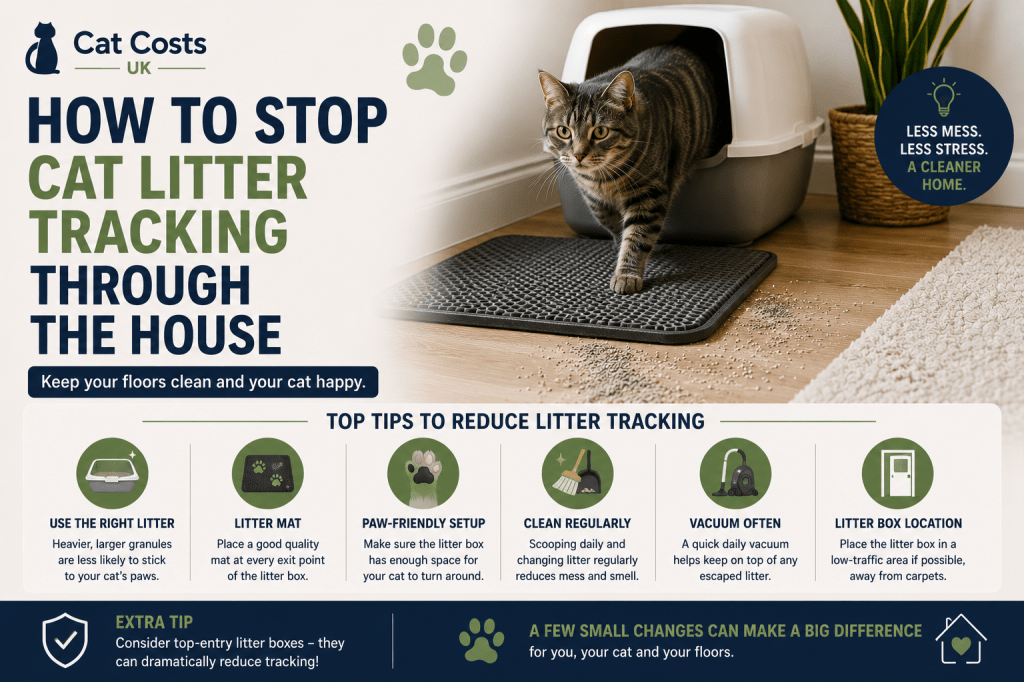
    Cat litter tracking is one of the most common annoyances for indoor cat owners. Litter can spread from the tray into hallways, kitchens, bedrooms and sofas, especially if the tray is in a busy area or your cat kicks litter when digging.

    How to stop cat litter tracking: quick answer

    The best way to reduce cat litter tracking is to use a good litter mat, place the tray in a lower-traffic area, keep the tray clean, and consider a larger or covered litter box if your cat kicks litter out. Changing litter type may also help, but do it gradually.

    Quick fixes for litter tracking

    FixBest forCompare options
    Litter matCatching litter as your cat exits the trayCompare litter mats
    Larger litter trayCats that dig or kick litter outCompare large trays
    Covered litter boxContaining kicked litterCompare covered boxes
    Low-tracking litterReducing spread from pawsCompare low-tracking litter

    1. Use a proper litter mat

    A litter mat is usually the easiest first fix. Place it directly outside the tray entrance so your cat has to step onto it when leaving. Larger mats usually work better than tiny mats because cats often jump or step over small ones.

    Compare large cat litter mats on Amazon.

    2. Move the tray away from high-traffic areas

    If the tray sits beside a doorway, kitchen walkway or living room entrance, litter is more likely to spread. Moving the tray slightly can reduce how far litter travels, as long as the new location still feels safe and accessible for your cat.

    3. Try a larger litter tray

    Some cats track litter because the tray is too small or they kick litter over the sides. A larger tray gives them more room to turn, dig and cover without throwing as much litter onto the floor.

    Compare large cat litter trays on Amazon.

    4. Consider a covered litter box

    Covered litter boxes can help contain kicked litter, but not every cat likes them. If your cat dislikes enclosed spaces or stops using the tray, switch back to an open tray and try a mat or larger tray instead.

    Compare covered cat litter boxes on Amazon.

    5. Change litter type carefully

    Some litters track more than others. Larger granules may spread less, while very lightweight litter can travel further. Change litter gradually where possible, as sudden changes can put some cats off using the tray.

    Compare low-tracking cat litter on Amazon.

    What to avoid

    • Do not move the tray somewhere your cat feels unsafe.
    • Do not suddenly change every part of the litter setup at once.
    • Do not use strong-smelling cleaning products around the tray.
    • Do not force a covered box if your cat clearly dislikes it.
    • Do not ignore sudden litter tray issues, as they can sometimes indicate stress or health concerns.

    My recommendation

    Start with a large litter mat and a sensible tray position. If litter still spreads, try a larger tray or covered litter box before changing litter type completely.

    Related guides

    FAQs

    What is the best way to stop cat litter tracking?

    The best first step is usually a large litter mat placed directly outside the tray, combined with a clean, well-positioned litter tray.

    Do covered litter boxes stop tracking?

    They can reduce kicked litter, but they do not stop all tracking from paws. Some cats also dislike covered boxes.

    Does low-tracking cat litter work?

    It may help, but results vary by cat, tray and home layout. Change litter gradually to avoid putting your cat off the tray.

    Last updated: 2 July 2026

  • Best Indoor Cat Enrichment Ideas UK

    Best Indoor Cat Enrichment Ideas UK

    Affiliate disclosure: This article contains Amazon affiliate links. As an Amazon Associate, Cat Costs UK earns from qualifying purchases.

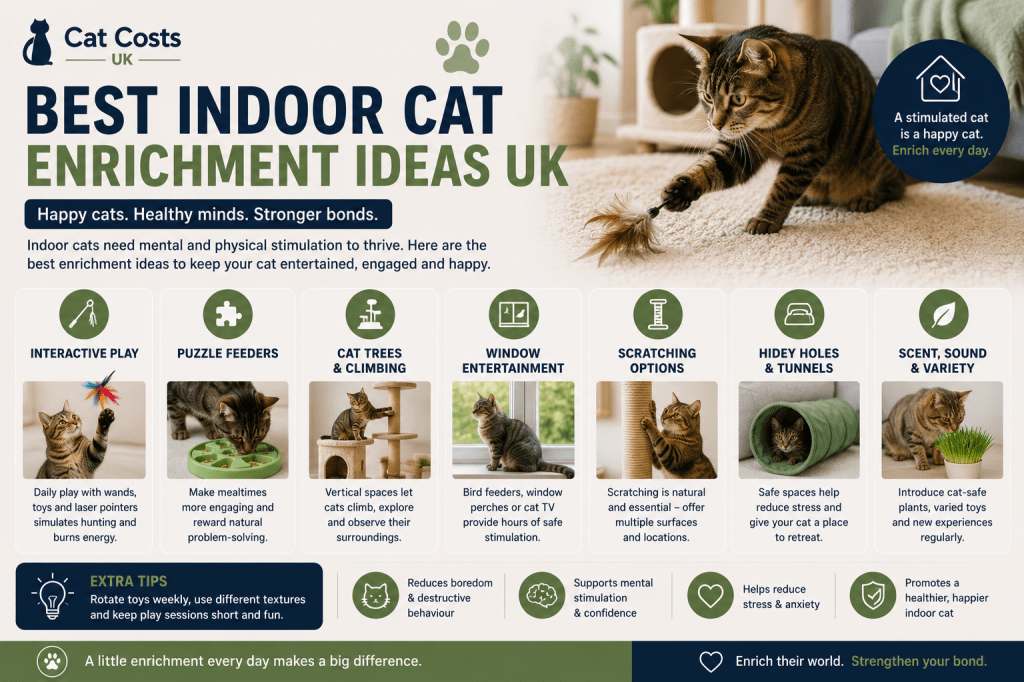
    Indoor cats can live happy, healthy lives, but they often need more help with play, climbing, scratching, exploring and routine. Good enrichment does not need to be expensive; the aim is to give your cat more choice, movement and interest throughout the day.

    Indoor cat enrichment: quick answer

    The best indoor cat enrichment ideas are daily interactive play, scratching posts, cat trees or window perches, puzzle toys, treat games, tunnels, hiding spots and rotating toys. Start with low-cost options, then upgrade based on what your cat actually uses.

    Quick indoor enrichment ideas

    Enrichment needIdeaWhy it helpsCompare options
    ExerciseWand toysEncourages chasing, pouncing and jumping.Compare wand toys
    ClimbingCat treeAdds vertical space and resting spots.Compare cat trees
    Watching outsideWindow perchGives indoor cats a comfortable lookout.Compare window perches
    Food gamesPuzzle toy or lick matMakes treats or meals more interesting.Compare puzzle toys
    HidingCat tunnelAdds play, hiding and stalking behaviour.Compare cat tunnels

    1. Add daily interactive play

    Interactive play is one of the best enrichment options because it involves you, not just the toy. Wand toys, feather teasers and chase toys can help your cat use natural hunting behaviours indoors.

    Compare interactive cat toys on Amazon.

    2. Give your cat vertical space

    Many cats like to climb, perch and watch from above. A cat tree is the easiest option for most homes, while wall shelves can work if they are installed securely.

    Compare indoor cat trees on Amazon.

    3. Use window perches and lookout spots

    A safe window perch can give indoor cats something to watch without needing to go outside. Check the fixing method, weight guidance and whether the perch suits your window type before buying.

    Compare cat window perches on Amazon.

    4. Try puzzle toys and treat games

    Puzzle toys, treat balls and lick mats can add variety to feeding and treat time. Start with easy puzzles so your cat does not get frustrated.

    Compare cat treat puzzle toys on Amazon.

    Low-cost enrichment ideas

    • Rotate toys instead of leaving everything out.
    • Use cardboard boxes as temporary hiding spots.
    • Place a blanket on a safe windowsill or chair.
    • Hide a few treats for your cat to find.
    • Move toys between rooms to make them feel new.
    • Use short play sessions rather than one long session.

    Higher-cost products to consider later

    • Exercise wheels: good for some active cats, but expensive and not guaranteed to be used.
    • Cat wall furniture: excellent for vertical space if installed safely.
    • Automatic feeders: useful for routine, not essential enrichment.
    • Cat cameras: helpful for checking behaviour while you are out.
    • Catios: a larger investment for safe outdoor-style enrichment.

    My recommendation

    Start with play, scratching, climbing and a window view before buying expensive products. The best enrichment setup is one your cat actually uses every day.

    Related guides

    FAQs

    How do I keep an indoor cat entertained?

    Use a mix of daily play, scratching posts, climbing space, window views, puzzle toys and toy rotation.

    Do indoor cats need a cat tree?

    They do not strictly need one, but a cat tree is one of the easiest ways to add climbing, scratching and resting space indoors.

    Are puzzle toys good for indoor cats?

    They can be useful for food-motivated cats, especially when introduced gradually with easy puzzles first.

    Last updated: 2 July 2026

  • Do Cats Actually Use Exercise Wheels?

    Do Cats Actually Use Exercise Wheels?

    Affiliate disclosure: This article contains Amazon affiliate links. As an Amazon Associate, Cat Costs UK earns from qualifying purchases.

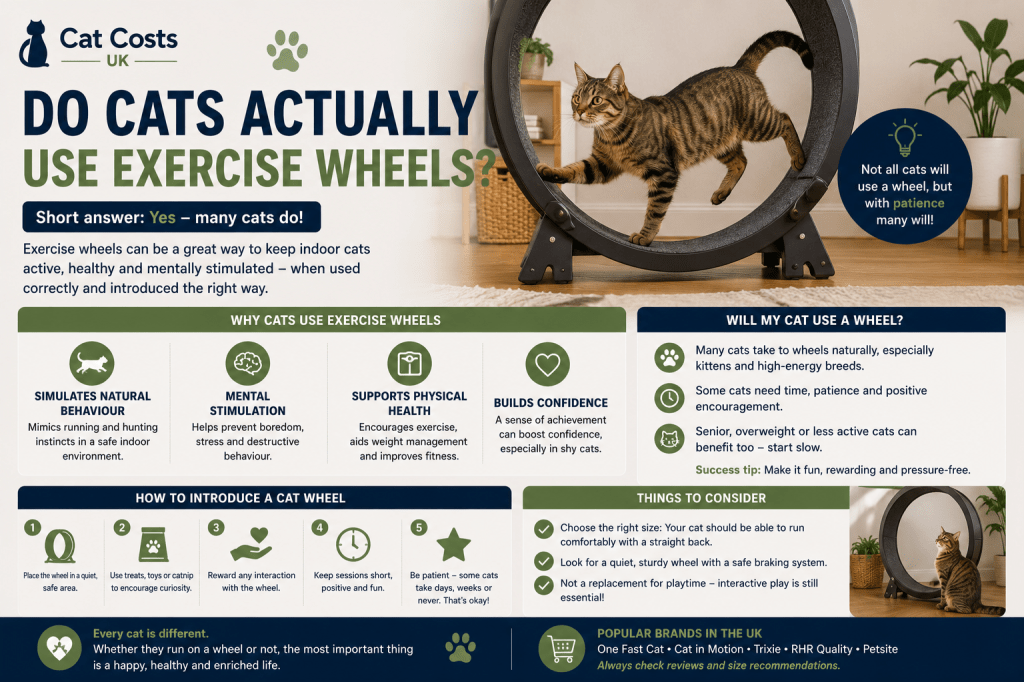
    Cat exercise wheels look impressive, but they are not a guaranteed win. Some cats use them regularly, some need patient training, and some completely ignore them. Because they are usually expensive and large, it is worth being realistic before buying.

    Do cats actually use exercise wheels? Quick answer

    Some cats do use exercise wheels, especially active indoor cats, young cats and cats that enjoy climbing, chasing and high-energy play. However, many cats will not use one without training, and some never take to it at all.

    Which cats are most likely to use one?

    • Active indoor cats with lots of energy.
    • Younger cats that enjoy chasing and climbing.
    • Cats already interested in moving toys.
    • Food-motivated cats that respond to gradual training.
    • Confident cats that are not easily startled by movement or noise.

    Which cats may ignore an exercise wheel?

    • Very nervous cats.
    • Older cats that prefer quiet resting spots.
    • Cats with mobility concerns.
    • Cats that dislike unstable or moving surfaces.
    • Cats that already ignore most enrichment products.

    Before buying: cheaper alternatives to try first

    AlternativeWhy try it firstCompare options
    Wand toysCheaper way to test high-energy play.Compare wand toys
    Cat tunnelsGood for chasing and hiding games.Compare tunnels
    Cat treesAdds climbing and scratching without training.Compare cat trees
    Puzzle toysUseful for food-motivated enrichment.Compare puzzle toys

    When a cat exercise wheel is worth it

    A cat exercise wheel may be worth it if your cat is active, indoor-only, confident, and you have already seen them enjoy movement-based play. It is more likely to be worth the money if you also have enough floor space and patience to introduce it gradually.

    Compare cat exercise wheels on Amazon.

    What to check before buying

    • Wheel size: check the diameter suits your cat’s size.
    • Stability: the base should feel secure and not wobble.
    • Noise: noisy wheels may put cats off.
    • Floor space: wheels can take up more room than expected.
    • Training: most cats need slow, positive introduction.
    • Returns: check return policy in case your cat ignores it.
    • Health: speak to a vet if your cat has mobility or weight concerns.

    My recommendation

    Do not buy an exercise wheel as your first enrichment product. Try toys, tunnels, climbing furniture and puzzle toys first. If your cat is clearly active and enjoys movement, then compare exercise wheels carefully.

    Related guides

    FAQs

    Do cats really use exercise wheels?

    Some cats do, but not all. Active, confident indoor cats are usually more likely to use them than nervous or low-energy cats.

    Are cat exercise wheels worth the money?

    They can be worth it for the right cat, but they are expensive and not guaranteed to be used. Try cheaper enrichment first.

    How do you train a cat to use an exercise wheel?

    Introduce it slowly with treats, toys and short positive sessions. Never force your cat onto the wheel.

    Last updated: 2 July 2026

  • Catio vs Cat Harness UK

    Catio vs Cat Harness UK

    Affiliate disclosure: This article contains Amazon affiliate links. As an Amazon Associate, Cat Costs UK earns from qualifying purchases.

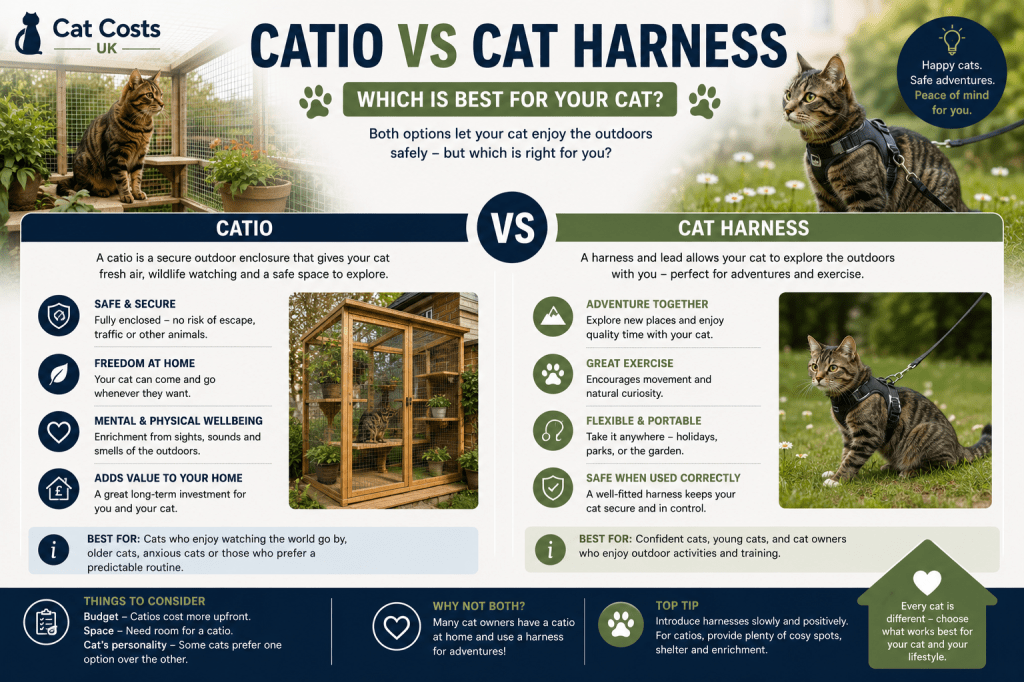
    Catios and cat harnesses are two popular ways to give cats outdoor enrichment while keeping more control than free roaming. The better choice depends on your cat’s temperament, your space, your budget and how much training you are prepared to do.

    Catio vs cat harness: quick answer

    A catio is usually better if you want low-supervision outdoor access at home and have suitable space. A cat harness is usually cheaper and more flexible, but it needs patient training and close supervision every time it is used.

    Quick comparison

    OptionBest forWatch out forCompare
    CatioSafe garden or patio enrichmentHigher cost, space and setupCompare catios
    Cat harnessShort supervised outdoor sessionsTraining, escape risk and nervous catsCompare harnesses
    Outdoor cat houseSheltered garden resting spotNot a secure enclosureCompare outdoor houses
    Indoor enrichmentCats that dislike outdoor exposureNeeds variety indoorsCompare enrichment toys

    When a catio is better

    A catio is better if you have a garden, patio, balcony or suitable window space and want a more contained outdoor area. It can suit cats that enjoy fresh air and watching wildlife but are not suited to harness walks.

    Compare outdoor cat enclosures on Amazon.

    When a cat harness is better

    A cat harness is better if you want a lower-cost option and can supervise closely. It may suit calm, confident cats, but it needs careful introduction indoors before you ever go outside.

    Compare cat harnesses on Amazon.

    Safety and training points

    • Harness fit: check size carefully and test indoors first.
    • Supervision: never leave a cat unattended in a harness.
    • Catio security: check panels, doors, gaps and fixings regularly.
    • Temperament: nervous cats may prefer indoor enrichment.
    • Weather: avoid hot, cold or stressful outdoor conditions.
    • Escape routes: think about what happens if your cat panics.

    Cost comparison

    A harness and lead is usually much cheaper than a catio. A catio costs more because you are paying for space, structure and setup. However, a catio may be better value long term if your cat uses it daily and you have the right home for it.

    My recommendation

    Choose a catio if you want a more permanent outdoor setup at home. Choose a harness only if your cat is calm enough for training and you are prepared to supervise every session closely.

    Related guides

    FAQs

    Is a catio safer than a harness?

    A secure catio is usually less dependent on training and handling, while a harness needs close supervision and a good fit every time.

    Are cat harnesses worth it?

    They can be worth it for calm, trainable cats, but not every cat will tolerate a harness or enjoy outdoor walks.

    Should indoor cats go outside?

    Some indoor cats enjoy supervised outdoor enrichment, but others are happier indoors. Consider your cat’s temperament, safety and stress level.

    Last updated: 2 July 2026

  • Catios for Indoor Cats UK

    Catios for Indoor Cats UK

    Affiliate disclosure: This article contains Amazon affiliate links. As an Amazon Associate, Cat Costs UK earns from qualifying purchases.

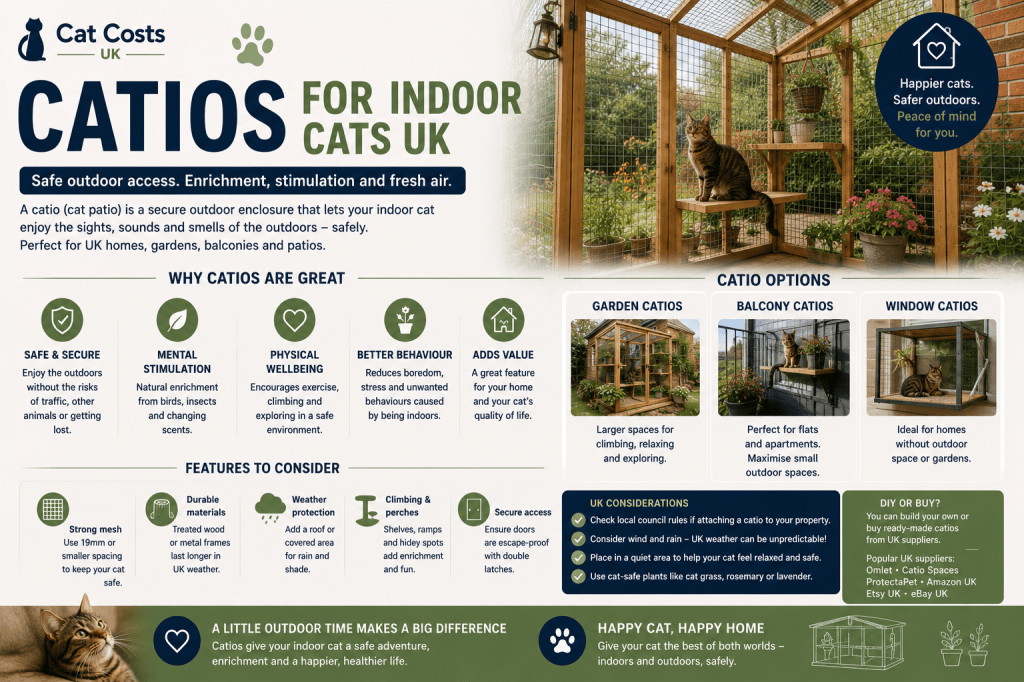
    A catio can give an indoor cat access to fresh air, smells and outdoor views while keeping them contained. It can be a strong enrichment option, but it is not the cheapest or simplest purchase, so it is worth checking space, safety and alternatives first.

    Catios for indoor cats: quick answer

    A catio can be worth it for indoor cats if you have suitable space, can install it securely, and your cat enjoys watching or smelling the outdoors. If you rent, have limited space or want a cheaper option, a window perch, cat tree or harness may be better to try first.

    Types of catios to consider

    Catio typeBest forWatch out forCompare
    Outdoor enclosureGardens and patiosSpace, weather and setupCompare outdoor enclosures
    Window catioSmaller homesSecure fixing and accessCompare window catios
    Balcony catioFlats with suitable balconiesPermission and fall safetyCompare balcony enclosures
    Portable enclosureOccasional supervised useLess permanent and may be less secureCompare portable enclosures

    Benefits of a catio

    • Gives indoor cats a new enrichment area.
    • Lets cats experience outdoor smells, sounds and views.
    • Can add climbing and resting space.
    • May reduce boredom for some cats.
    • Can be used alongside indoor toys, cat trees and perches.

    Important safety checks

    • Gaps: check panels, doors and joins for escape points.
    • Fixing: make sure the enclosure is secure and stable.
    • Weather: provide shade, shelter and access back indoors where possible.
    • Supervision: supervise new setups until you trust the enclosure.
    • Rental homes: check permission before installing anything permanent.
    • Balconies: take extra care with height, gaps and building rules.

    When a catio may not be worth it

    A catio may not be worth it if you have no suitable space, cannot install it securely, rent without permission, or your cat is easily stressed by outdoor sounds. In those cases, indoor enrichment may be better value.

    Compare indoor cat enrichment toys on Amazon.

    Lower-cost alternatives

    My recommendation

    A catio is best if you want a long-term outdoor enrichment setup and can make it secure. If you are unsure, start with a window perch, cat tree or harness before spending more.

    Related guides

    FAQs

    Are catios good for indoor cats?

    They can be very useful for indoor cats that enjoy outdoor sights, sounds and smells, as long as the catio is secure and suitable for your home.

    Are catios expensive?

    They can be more expensive than basic indoor enrichment because you are paying for structure, space and setup. Portable options may cost less than permanent builds.

    Can you have a catio in a rented home?

    Possibly, but check permission before installing anything fixed, drilled or permanent. Portable enclosures may be easier for renters.

    Last updated: 2 July 2026

  • Are Self-Cleaning Litter Boxes Worth It in the UK?

    Are Self-Cleaning Litter Boxes Worth It in the UK?

    Affiliate disclosure: This article contains Amazon affiliate links. As an Amazon Associate, Cat Costs UK earns from qualifying purchases.

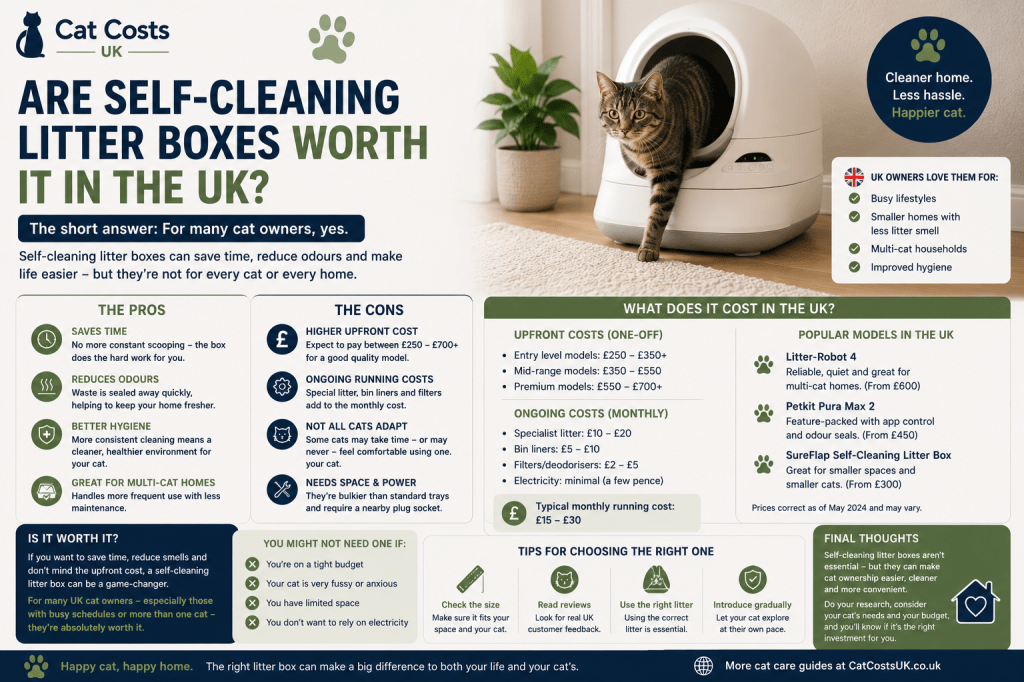
    Self-cleaning litter boxes can be appealing because they promise less scooping and a cleaner litter area. They can be useful for some homes, but they are expensive, take up space and not every cat will accept them.

    Are self-cleaning litter boxes worth it? Quick answer

    A self-cleaning litter box can be worth it if you want to reduce daily scooping, have the budget, and your cat is confident with enclosed or mechanical litter boxes. A normal litter tray is usually better if your cat is nervous, the space is small, or you want the simplest low-cost setup.

    Quick comparison

    OptionBest forWatch out forCompare
    Self-cleaning litter boxReducing daily scoopingHigh cost, space and cat acceptanceCompare self-cleaning boxes
    Covered litter boxContaining mess and odourSome cats dislike enclosed traysCompare covered boxes
    Large open traySimple, low-cost litter setupNeeds regular scoopingCompare large trays
    Litter matReducing tracked litterDoes not replace scoopingCompare litter mats

    When a self-cleaning litter box is worth it

    It may be worth it if you have a confident cat, enough room, and you strongly dislike daily scooping. It can also be useful in multi-cat homes, but you should check capacity and whether the product is suitable for more than one cat before buying.

    Compare automatic self-cleaning litter boxes on Amazon.

    When it may not be worth it

    It may not be worth it if your cat is nervous, dislikes covered trays, is sensitive to noise, or you do not have space for a large unit. It is also not maintenance-free: you still need to empty waste, clean parts and monitor whether your cat is using it normally.

    Hidden costs and practical issues

    • Upfront cost: self-cleaning boxes are usually much more expensive than normal trays.
    • Consumables: some models need liners, bags, filters or specific litter.
    • Space: many units are larger than expected.
    • Noise: mechanical movement may worry some cats.
    • Cleaning: automatic does not mean no cleaning.
    • Reliability: check recent customer feedback carefully.
    • Returns: important if your cat refuses to use it.

    Safety and cat acceptance checks

    • Introduce the new box gradually and keep the old tray available at first.
    • Do not force your cat into the unit.
    • Check sensor and safety information before use.
    • Watch for changes in litter habits.
    • Speak to a vet if your cat suddenly avoids the tray, strains, cries or changes toilet behaviour.

    My recommendation

    Buy a self-cleaning litter box only if you have a clear reason to upgrade and can afford the risk that your cat may not accept it. For many homes, a large tray, good litter mat and regular scooping is still the best-value setup.

    Related guides

    FAQs

    Are self-cleaning litter boxes worth the money?

    They can be worth it if reducing scooping is a high priority and your cat accepts the box, but they are not the best-value option for every home.

    Do self-cleaning litter boxes still need cleaning?

    Yes. You still need to empty waste, clean parts, replace consumables where required and check the unit is working properly.

    Will my cat use a self-cleaning litter box?

    Some cats use them well, while others dislike the movement, noise or enclosed design. Keep the old tray available during the changeover.

    Last updated: 2 July 2026