Affiliate disclosure: This article contains Amazon affiliate links. As an Amazon Associate, Cat Costs UK earns from qualifying purchases.
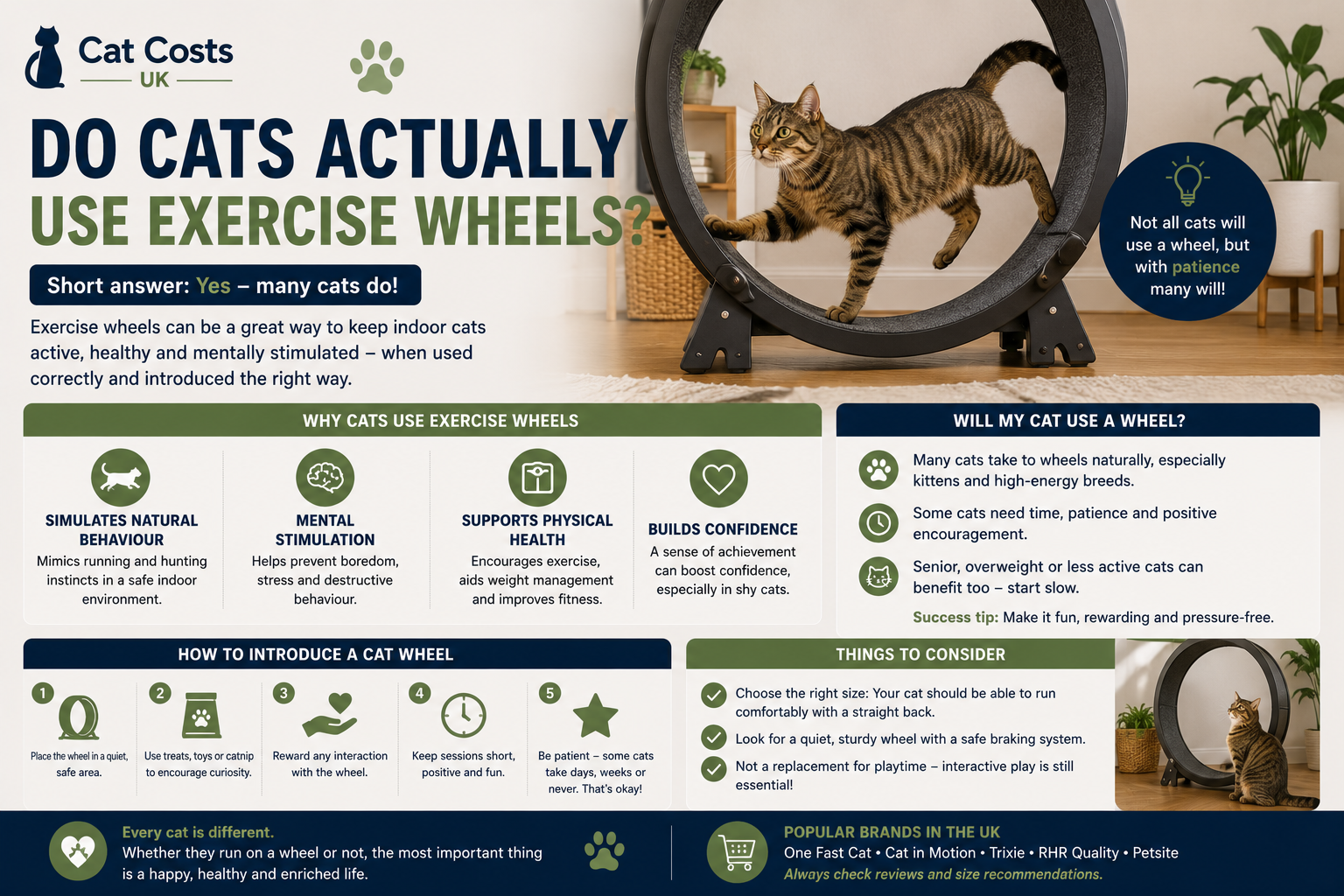
Cat exercise wheels look impressive, but they are not a guaranteed win. Some cats use them regularly, some need patient training, and some completely ignore them. Because they are usually expensive and large, it is worth being realistic before buying.
Do cats actually use exercise wheels? Quick answer
Some cats do use exercise wheels, especially active indoor cats, young cats and cats that enjoy climbing, chasing and high-energy play. However, many cats will not use one without training, and some never take to it at all.
Which cats are most likely to use one?
- Active indoor cats with lots of energy.
- Younger cats that enjoy chasing and climbing.
- Cats already interested in moving toys.
- Food-motivated cats that respond to gradual training.
- Confident cats that are not easily startled by movement or noise.
Which cats may ignore an exercise wheel?
- Very nervous cats.
- Older cats that prefer quiet resting spots.
- Cats with mobility concerns.
- Cats that dislike unstable or moving surfaces.
- Cats that already ignore most enrichment products.
Before buying: cheaper alternatives to try first
| Alternative | Why try it first | Compare options |
|---|---|---|
| Wand toys | Cheaper way to test high-energy play. | (Ad) Compare wand toys |
| Cat tunnels | Good for chasing and hiding games. | (Ad) Compare tunnels |
| Cat trees | Adds climbing and scratching without training. | (Ad) Compare cat trees |
| Puzzle toys | Useful for food-motivated enrichment. | (Ad) Compare puzzle toys |
When a cat exercise wheel is worth it
A cat exercise wheel may be worth it if your cat is active, indoor-only, confident, and you have already seen them enjoy movement-based play. It is more likely to be worth the money if you also have enough floor space and patience to introduce it gradually.
(Ad) Compare cat exercise wheels on Amazon.
What to check before buying
- Wheel size: check the diameter suits your cat’s size.
- Stability: the base should feel secure and not wobble.
- Noise: noisy wheels may put cats off.
- Floor space: wheels can take up more room than expected.
- Training: most cats need slow, positive introduction.
- Returns: check return policy in case your cat ignores it.
- Health: speak to a vet if your cat has mobility or weight concerns.
My recommendation
Do not buy an exercise wheel as your first enrichment product. Try toys, tunnels, climbing furniture and puzzle toys first. If your cat is clearly active and enjoys movement, then compare exercise wheels carefully.
Related guides
FAQs
Do cats really use exercise wheels?
Some cats do, but not all. Active, confident indoor cats are usually more likely to use them than nervous or low-energy cats.
Are cat exercise wheels worth the money?
They can be worth it for the right cat, but they are expensive and not guaranteed to be used. Try cheaper enrichment first.
How do you train a cat to use an exercise wheel?
Introduce it slowly with treats, toys and short positive sessions. Never force your cat onto the wheel.
Plan the wider cat setup
The product is only one part of the decision. Use the calculator to estimate the wider monthly budget, then browse the product hub for related essentials before you buy.
Last updated: 2 July 2026