Affiliate disclosure: This article contains Amazon affiliate links. As an Amazon Associate, Cat Costs UK earns from qualifying purchases.
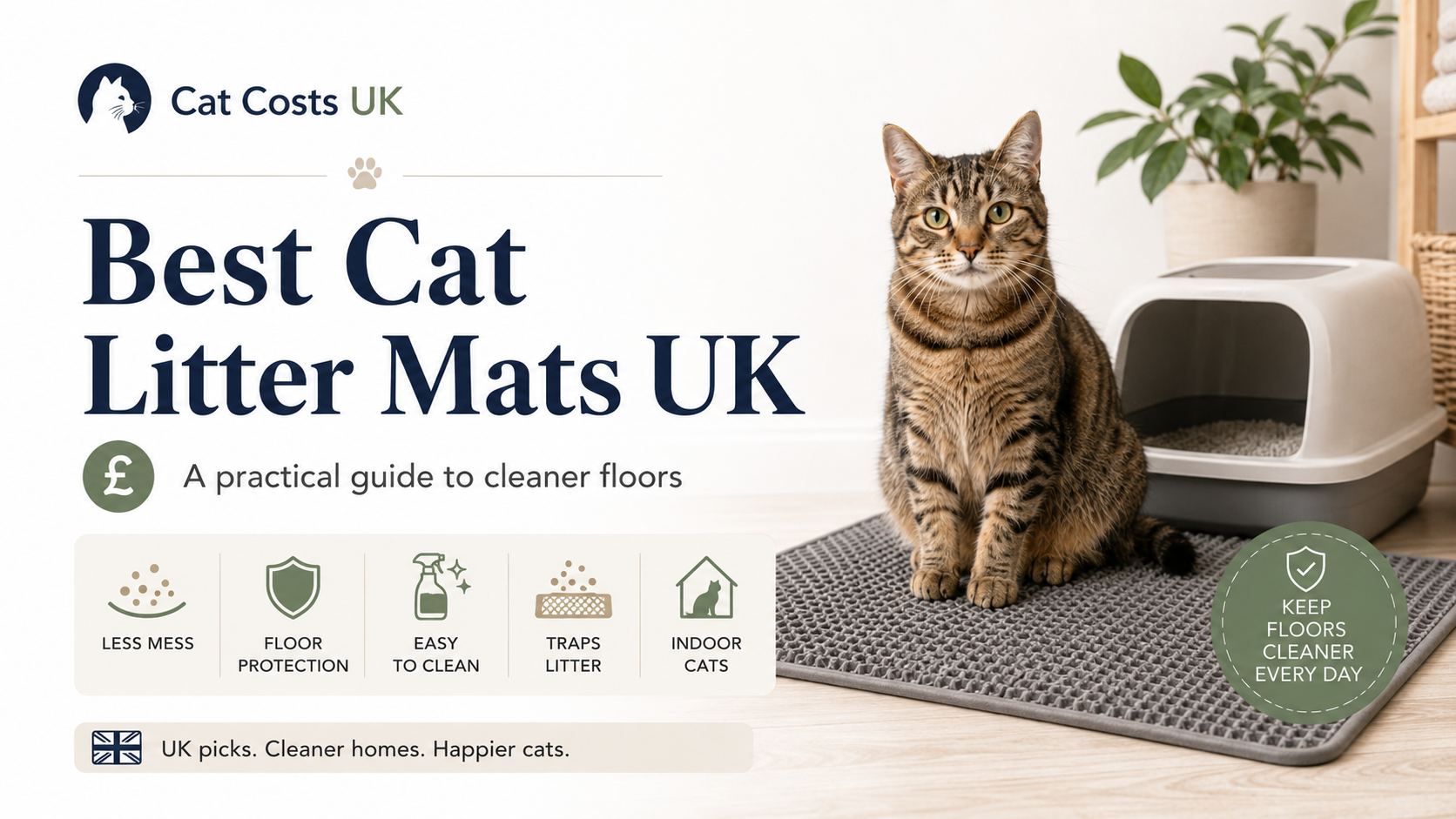
A cat litter mat is one of the easiest ways to reduce litter tracking around the house. It will not stop every grain of litter, but the right mat can catch a lot of mess as your cat leaves the tray.
Best cat litter mats UK: quick answer
For most homes, the best cat litter mat is a large, easy-clean mat placed directly outside the tray entrance. Honeycomb mats can be good for trapping litter, while waterproof mats are useful if you want easier cleaning around the litter area.
This guide compares cat litter mats by practical factors such as size, texture, cleaning method, waterproofing, comfort under paws, placement and how well the mat suits your tray setup.
Unless stated otherwise, products have not been hands-on tested by Cat Costs UK. Always check current product dimensions, material, cleaning instructions, return policies and customer feedback before buying.
Best overall: large cat litter mats
A larger mat usually works better than a tiny one because cats often step or jump beyond small mats. Place the mat so your cat naturally walks across it when leaving the tray.
Honeycomb litter mats are designed to trap litter in holes or layers, making it easier to tip the litter back into the tray or empty it into the bin. Check whether the mat opens easily for cleaning.
Cleaning: check whether it can be shaken, vacuumed or rinsed.
Waterproofing: useful for messy litter areas.
Placement: put it where your cat exits the tray.
Tray type: match the mat to an open, covered or top-entry box.
Durability: check if the material copes with scratching.
My recommendation
Start with a large, easy-clean litter mat before changing your whole litter setup. If tracking remains a problem, combine the mat with a larger tray or covered litter box.
They can reduce tracking, but they will not stop every bit of litter. Size and placement make a big difference.
What type of litter mat is best?
A large, easy-clean mat is best for most homes. Honeycomb mats can be especially useful for trapping litter.
Where should I put a cat litter mat?
Place it directly outside the tray entrance so your cat naturally walks across it when leaving the tray.
Plan the wider cat setup
The product is only one part of the decision. Use the calculator to estimate the wider monthly budget, then browse the product hub for related essentials before you buy.
Affiliate disclosure: This article contains Amazon affiliate links. As an Amazon Associate, Cat Costs UK earns from qualifying purchases.
A good cat bowl should be easy to clean, stable and comfortable for your cat to eat from. The best choice depends on whether you want a basic food bowl, a water bowl, a raised bowl, or a slow feeder for fast eaters.
Best cat bowls UK: quick answer
For most cats, a shallow stainless steel or ceramic bowl is a good starting point because it is easy to clean and less likely to hold smells than some plastic bowls. Raised bowls and slow feeders can be useful for specific needs, but they are not essential for every cat.
This guide compares cat bowls by practical factors such as material, depth, width, cleaning, stability, whisker comfort, raised designs, slow feeding and whether a fountain or automatic feeder would suit your routine better.
Unless stated otherwise, products have not been hands-on tested by Cat Costs UK. Always check current product dimensions, cleaning instructions, return policies and customer feedback before buying.
Best overall: stainless steel cat bowls
Stainless steel bowls are a practical choice for many homes because they are durable, easy to clean and usually simple to replace. Choose a shallow, stable bowl rather than a deep narrow one.
Slow feeder bowls can help some cats eat more slowly. They are not suitable for every cat, and you should speak to a vet if your cat is suddenly eating much faster, vomiting after meals or showing appetite changes.
Material: stainless steel and ceramic are easy to clean.
Depth: shallow bowls are often more comfortable.
Stability: heavier bowls or non-slip bases reduce sliding.
Cleaning: check whether the bowl is dishwasher safe.
Water placement: many cats prefer water away from food.
Fast eating: consider slow feeders if your cat bolts food.
Routine: consider an automatic feeder if you need timed meals.
My recommendation
Choose simple stainless steel or ceramic bowls for most cats. Add a slow feeder, raised bowl, fountain or automatic feeder only if it solves a real problem in your routine.
A shallow stainless steel or ceramic bowl is a good starting point for most cats because it is practical and easy to clean.
Are raised cat bowls better?
They can be useful for some cats, but they are not essential for every cat. Choose based on comfort and your cat’s eating habits.
Do cats need separate food and water bowls?
Yes. Many cats prefer water away from food, so it is worth placing a water bowl in a separate spot.
Plan the wider cat setup
The product is only one part of the decision. Use the calculator to estimate the wider monthly budget, then browse the product hub for related essentials before you buy.
Ad: This guide contains Amazon affiliate links. As an Amazon Associate I earn from qualifying purchases, at no extra cost to you.
For most cat owners, a simple manual flea comb is the place to start. You want closely spaced teeth, a grip you can control and a comb that is easy to clean between strokes. Among the options below, the Honoflux six-piece set is the most straightforward choice for checking the coat; the Nexalithix electric comb is an alternative to compare if your cat already tolerates powered grooming.
A flea comb can help you find fleas and flea dirt and remove some of what you catch. It will not prevent fleas returning or clear an infestation by itself. If you find signs of fleas, arrange suitable treatment with your vet.
How we chose: we compared the selected UK listings, the tool’s purpose, handling and cleaning needs, and animal-welfare guidance. Cat Costs UK has not hands-on tested these products.
Flea combs at a glance: which tool do you need?
Product
Choose it for
Main trade-off
Honoflux six-piece comb set
Manual flea and flea-dirt checks
Several shapes to try; you may only use one or two
Nexalithix electric flea comb
Comparing a powered comb with suction and a collection box
Charging and cleaning; your cat may dislike powered grooming
Bugalugs deshedding brush, pink
Removing loose hair during grooming
A separate job from a close flea-dirt check
Buddycare Flea & Tick Cat Shampoo, 500ml
Reading the label and discussing suitability with your vet
Not a comb or a complete flea-control plan; ingredient questions need checking
Buying just one tool for flea checks? Start with the manual set below. You do not need a shampoo or a deshedding brush simply because you are buying a flea comb.
1. Honoflux manual flea comb set: our first choice for coat checks
A six-piece manual set for gentle flea-dirt checks. Choose the fine-tooth comb that is easiest to hold; you do not need every shape. Do not pull through knots or mats.
We earn a commission if you make a purchase, at no additional cost to you.
11/04/2026 03:54 am GMT
This six-piece set makes sense if you want to try different comb shapes and find one you can hold comfortably. The listing describes fine stainless-steel teeth and includes tools marketed for pet grooming. The useful part is the fine-tooth comb you can pass gently through small sections of coat and inspect afterwards.
A manual comb gives you direct control: when it catches, you can stop immediately. There is no battery to charge or motor to introduce to a nervous cat. For a quick check around the neck or tail base, that simplicity is a good reason to choose it.
The drawback: six pieces do not mean six essential tools. You may settle on a single favourite, and the listing does not establish that this set catches more fleas than another well-made fine-tooth comb. Check the product photos for the handle shape you prefer. Inspect the teeth before first use and stop if they snag or feel rough.
Best fit: owners who want an uncomplicated manual check, including short-haired cats and longer coats that are free of tangles.
2. Nexalithix electric flea comb: worth comparing for powered grooming
The Nexalithix combines a rechargeable comb with suction and a collection box, according to its Amazon listing. The appeal is containing hair and debris as you groom, rather than wiping everything off the teeth by hand. The seller also advertises rotating teeth and a blue light.
Those features are not proof of better flea control. We have not independently verified its flea-removal performance, noise level or battery life. A blue light should not be treated as a flea diagnosis. This is an option to investigate if your cat is comfortable with powered grooming; a quiet manual comb is the easier starting point for a nervous cat.
Rechargeable comb with suction and a collection box, according to the listing. Worth comparing for cats comfortable with powered grooming. Flea-removal performance and noise have not been independently tested by us.
We earn a commission if you make a purchase, at no additional cost to you.
11/04/2026 03:17 am GMT
The drawback: it adds charging, a collection box to clean and a new sensation for your cat to get used to. Read the operating and cleaning instructions before buying, particularly if you plan to use it around sensitive areas. Do not assume it can be washed like a plain metal comb.
Bugalugs deshedding brush: an extra for loose fur
If your second problem is loose hair on clothes and furniture, the pink Bugalugs deshedding brush has a different purpose. Its wide, shallow comb is intended for removing loose hair and undercoat. The brand describes a stainless-steel comb and an ergonomic handle; its instructions call for a clean, dry coat, light strokes in the direction of hair growth and avoiding sensitive facial areas.
A separate grooming tool for loose hair and undercoat. Use gentle strokes on a clean, dry, tangle-free coat. Choose a dedicated fine-tooth flea comb for close flea-dirt checks.
We earn a commission if you make a purchase, at no additional cost to you.
11/04/2026 03:17 am GMT
Buy it for grooming, rather than relying on it for flea checks. A dedicated fine-tooth flea comb is the clearer choice when you want to inspect tiny black specks. The deshedding brush also needs care: do not keep working the same patch, press hard or use it on sore skin. It is not a tool for dragging through mats.
Not automatically. A comb helps you inspect the coat; shampoo involves bathing, and it does not solve the whole flea life cycle. Blue Cross explains that flea shampoo is not an effective long-term solution because it does not prevent eggs hatching.
The Buddycare Flea & Tick Cat Shampoo, 500ml, is listed on Amazon (Ad). Its manufacturer lists tea tree and eucalyptus oils. The product page also contains conflicting cat and dog FAQ wording. We would ask a vet about this exact formulation before using it, especially on a kitten or a cat with irritated skin. “Natural” alone does not establish suitability for cats.
We have included the listing so you can identify the product, but it is not our recommended add-on for this guide. If you find fleas, put the treatment decision ahead of buying another grooming product.
How to choose a flea comb for your cat’s coat
Short-haired cats: look for fine, closely spaced teeth and a grip you can hold steadily. A small, simple manual comb is usually enough for close checks.
Long-haired cats: work in small sections and deal with loose tangles using a suitable grooming comb first. Fine flea-comb teeth can catch in knots; more pressure is not the answer.
Kittens: favour a small tool you can control and very short, gentle sessions. If a young kitten has fleas, ask your vet promptly about age-appropriate treatment.
Nervous cats: start with a quiet manual tool and stop before the cat becomes distressed. A powered brush only helps if your cat tolerates it.
Cleaning: choose teeth you can inspect and clear easily. Follow the product instructions, and dry a washed manual comb before storing it.
How to use a flea comb properly
Set up a short, calm session. Have a light-coloured towel, damp white kitchen roll or cotton wool, and somewhere to clean the comb ready.
Comb gently with the coat. Take small sections, including around the neck and base of the tail. Avoid sore patches, eyes and other sensitive areas. Stop if the comb catches or your cat becomes uncomfortable.
Look at what you catch. Wipe black specks onto the damp white material. Flea dirt can leave a reddish-brown mark when wet.
Clear the teeth between passes. For a washable manual comb, Cats Protection suggests dipping it in soapy water to remove caught fleas, then drying it before combing again. Follow separate instructions for electric tools; do not dip the electrical unit in water.
Act on the result. Fleas, flea dirt or continuing symptoms need a suitable treatment plan. A clean-looking comb does not rule fleas out.
What a flea comb can and cannot do
A flea comb can help you inspect the coat, catch some fleas and debris, and check suspicious specks. It cannot stop new fleas arriving or treat the home. Persistent scratching can also have other causes, so finding no fleas is not a diagnosis.
When to speak to a vet
Contact your vet if you find fleas or flea dirt, or if your cat has repeated scratching, scabs, bald patches or inflamed skin. Kittens can become ill more quickly from fleas, so seek prompt advice for a young kitten. Treatment may need to cover other pets and the home. Never use a dog flea treatment on a cat.
Flea comb questions
Do flea combs work on cats?
They are useful for close coat checks and can remove some fleas. They work best as part of checking and grooming, alongside an appropriate flea-control plan if needed.
What is the best flea comb for long-haired cats?
Choose fine, smooth teeth and a handle you can control. A longer coat needs small sections and careful preparation, not necessarily an electric tool. If the coat is matted, stop and ask a vet or qualified groomer for help.
Is a nit comb the same as a flea comb?
Both may have closely spaced teeth, but the names alone do not tell you whether a tool suits your cat. Check that the exact comb is intended for pet grooming, has suitable teeth and can be held comfortably. The Honoflux listing uses both terms and explicitly includes cats.
Are electric flea combs better than manual combs?
We do not have independent evidence establishing that the selected electric comb is better. Suction may be convenient for collecting debris, but tolerance, cleaning and control matter too. A manual comb is the practical first purchase for most owners.
How often should I flea-comb my cat?
Use short checks as part of grooming and when you suspect fleas. The right frequency depends on your cat’s coat, comfort and treatment plan; repeated combing should not irritate the skin or delay veterinary advice.
Which flea comb should you buy?
Start with the Honoflux manual set if your aim is a straightforward flea-dirt check. Pick the shape you find easiest to hold and keep sessions gentle. Compare the Nexalithix only if suction and powered grooming are features you actually want. Add the Bugalugs brush for a separate loose-hair problem; leave shampoo out of the basket until its suitability is clear.
Affiliate disclosure: This article contains Amazon affiliate links. As an Amazon Associate, Cat Costs UK earns from qualifying purchases.
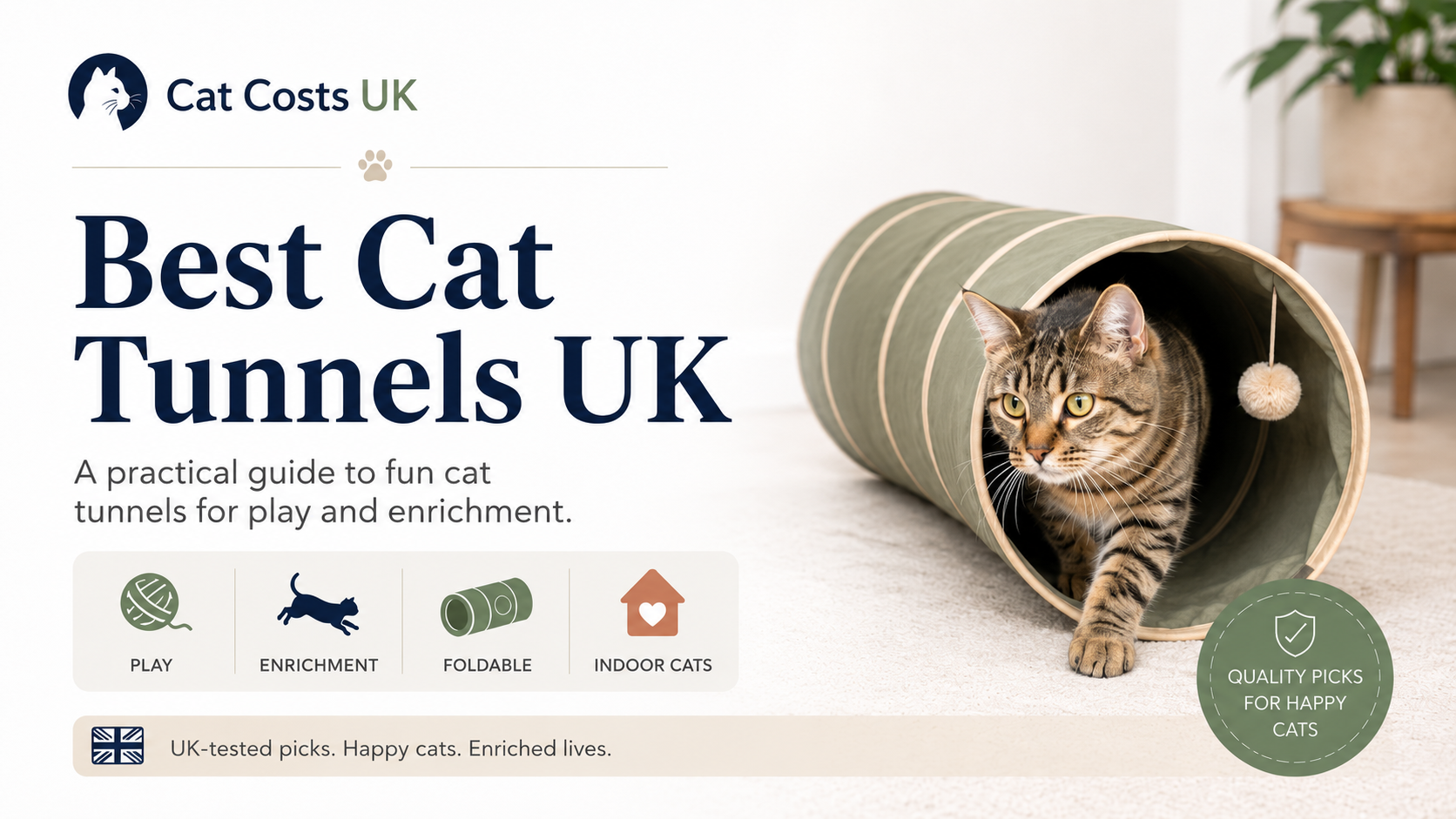
Cat tunnels are a simple enrichment product for play, hiding, chasing and stalking. They are usually cheaper than cat trees or exercise wheels, making them a good first upgrade for indoor cats that need more activity.
Best cat tunnels UK: quick answer
For most cats, the best cat tunnel is a collapsible crinkle tunnel with enough width for comfortable movement, multiple openings and durable material. If your cat is nervous, start with a shorter tunnel before buying a larger multi-way design.
This guide compares cat tunnels by practical factors such as length, width, openings, material, noise, storage, cleaning and whether the tunnel suits your cat’s confidence and play style.
Unless stated otherwise, products have not been hands-on tested by Cat Costs UK. Always check current product dimensions, material, safety notes, return policies and customer feedback before buying.
Best overall: crinkle cat tunnels
Crinkle tunnels are popular because the sound and movement can make play more exciting. They are a good option for cats that enjoy chasing toys, hiding and ambushing during play sessions.
Collapsible tunnels are useful if you do not want cat toys spread across the room all day. They can be folded away, then brought out for play sessions to make them feel more interesting.
Width: make sure your cat can move through comfortably.
Length: longer tunnels are better for active play.
Openings: side holes can add more play options.
Noise: some cats love crinkle sound; others avoid it.
Storage: collapsible designs are useful in small homes.
Material: check durability if your cat scratches or bites toys.
Safety: remove damaged toys if wires or parts become exposed.
My recommendation
Start with a simple collapsible crinkle tunnel because it is affordable, easy to store and works for many indoor cats. If your cat loves it, upgrade later to a longer or multi-way tunnel.
Many cats enjoy tunnels for hiding, chasing and ambushing toys, but some nervous cats may need a slow introduction.
Are crinkle cat tunnels good?
They can be good for playful cats because the sound adds interest, but some cats dislike the noise.
Are cat tunnels good for indoor cats?
Yes, they can be a low-cost enrichment option for indoor cats, especially when used with interactive play.
Plan the wider cat setup
The product is only one part of the decision. Use the calculator to estimate the wider monthly budget, then browse the product hub for related essentials before you buy.
Ad: This guide contains paid Amazon links. As an Amazon Associate, Cat Costs UK earns from qualifying purchases, at no extra cost to you.
The best cat food container is the one you can close easily, fit in your cupboard and clean between bags. A huge “airtight” bin is no bargain if your usual bag will not fit inside it. We checked the exact Amazon UK listings below on 26 September 2026 and picked three for different homes.
Our quick pick: choose the Curver 10L for a compact everyday container; the Rotho Cody 25L if you buy bigger bags and want more capacity for the money; or the simplehuman 25L when a locking handle matters more than price.
Compact everyday storage — Curver 10L. A smaller footprint for tighter kitchens. Ad: check the Curver 10L on Amazon and confirm your usual bag will fit.
More room for the money — Rotho Cody 25L. Includes a pouring flap and scoop; measure the space first. Ad: check the Rotho Cody on Amazon.
The hero image is illustrative and does not show one of the recommended models. These are researched picks, not hands-on tests. We used product specifications and live retailer listings, and weighed size, access, cleaning and price against one another. Amazon prices, sellers and stock can change; check the exact variant on the destination page.
Best compact choice: Curver 10L cat food container
Buy this if you keep a modest bag of dry food in a cupboard and want a manageable container for daily feeding. At 10L, it is easier to find space for than a 25L floor bin. That is useful in a small kitchen, where a container you can actually put away beats a bigger one left beside the bowl.
The catch: litres describe the container, not the size of bag it will swallow. A bag of kibble still in its packaging needs more room than the same weight poured loose. Measure your usual bag and compare the listing dimensions before ordering. If you routinely buy bulk bags, go straight to a larger option.
Buy this if you want a roomy dry-food bin without paying for a premium metal one. The cat-pattern Cody has a pouring flap and included scoop. Rotho lists it at 25L and 33 × 25 × 46.2cm externally, so check your shelf height as well as floor space. It is a sensible step up when the 10L option is too small.
The catch: a lidded plastic bin is not a guarantee against a determined cat. Keep it in a cupboard if your cat has learned to open lids. And do not assume “25L” means a particular weight of kibble will fit in its original bag; bag shapes and kibble density differ.
Buy this if food has to stay somewhere your cat can reach. The simplehuman CW1887 has a locking handle, a removable inner bucket and a scoop under the lid. The lock is its main advantage over an ordinary plastic tub; the bucket also makes washing less awkward.
The catch: it costs considerably more and occupies more space than the other two picks. No lid is a promise that every cat will give up, so a closed cupboard is still the safest bet for a persistent food thief. Check the interior measurements before buying it for an unopened bag.
Start with the bag you actually buy. If you want to store it unopened, measure its height, width and depth after allowing for the way it folds. Compare that with the container’s inside dimensions, not just its litre rating. A tall pouring bin may look roomy but have a narrow opening. If you decant food, retain the bag’s batch and best-before details.
For a small kitchen or frequent small purchases, 10L is the first size to investigate. For larger purchases, consider 25L, but only after checking the bag and the space where the bin will stand. Buy a locking model if access is the real problem; extra capacity alone will not stop a cat opening a lid.
Should you leave kibble in its original bag?
If it fits, yes. The FDA recommends putting the entire dry-food bag inside the container. The bag protects the food and preserves the batch number and best-before date in case of a problem or recall. If you pour kibble into a bin instead, keep a photo of the label, wash and completely dry the bin between bags, and follow the food manufacturer’s storage advice. Store it somewhere cool and dry.
Quick answers before you buy
Does “airtight” keep cat food fresh forever?
No. A well-closing lid can limit spills and exposure to air, but it does not reset the food’s best-before date. Buy a bag your cat will eat within the maker’s guidance and close it properly after each feed.
Can these bins store opened wet cat food?
No. These picks are for dry food. Refrigerate opened wet food promptly in a covered container and follow its label for storage time.
Which one should I buy?
If a 10L bin fits your usual bag and cupboard, start with the Curver. For a larger bag on a more modest budget, choose the Rotho. Pay extra for the simplehuman only if the locking handle and removable bucket solve a problem you actually have.
Research checked: 26 September 2026. We did not physically test these bins; availability and specifications may change.
Affiliate disclosure: This article contains Amazon affiliate links. As an Amazon Associate, Cat Costs UK earns from qualifying purchases.
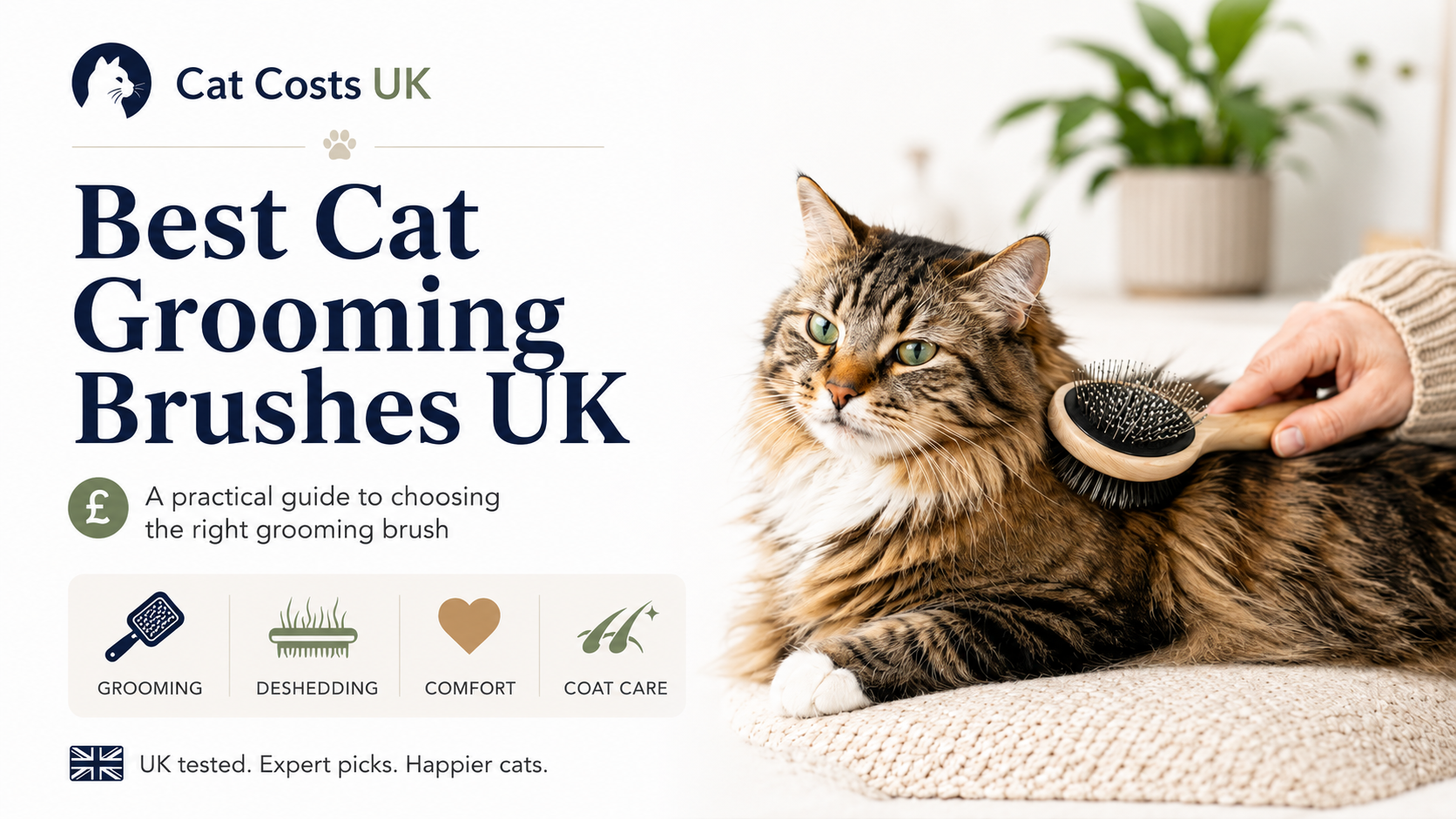
A good cat grooming brush can help with loose fur, shedding and coat maintenance, but the best choice depends on your cat’s coat type, tolerance for grooming and whether you need gentle brushing or more serious deshedding support.
Best cat grooming brushes UK: quick answer
For most cats, start with a gentle slicker brush, soft brush or grooming glove. Long-haired cats may need a comb as well, while heavy-shedding cats may benefit from a deshedding tool used carefully.
This guide compares cat grooming brushes by practical factors such as coat length, brush type, comfort, grip, cleaning, shedding control and whether your cat is likely to tolerate regular grooming.
Unless stated otherwise, products have not been hands-on tested by Cat Costs UK. Always check current product details, coat suitability, safety guidance, return policies and customer feedback before buying.
Best overall: gentle grooming brushes
A gentle brush or grooming glove is a sensible first choice if your cat is not used to grooming. Short, positive sessions are usually better than trying to brush the whole coat at once.
Deshedding tools can help with loose undercoat, but they should be used carefully and not too aggressively. If your cat has mats, bald patches, sore skin or sudden coat changes, ask a vet or groomer for advice.
Coat type: short-haired and long-haired cats may need different tools.
Comfort: avoid harsh brushes if your cat is sensitive.
Grip: a comfortable handle helps you brush gently.
Cleaning: self-cleaning brush buttons can be useful.
Skin: do not brush over sore or irritated areas.
Grooming tolerance: nervous cats may prefer gloves or soft brushes.
Knots: do not pull hard through mats or tangles.
My recommendation
Start with a gentle brush or grooming glove, then add a comb or deshedding tool only if your cat’s coat needs it. Keep sessions short and positive so grooming becomes easier over time.
A gentle grooming brush, slicker brush or grooming glove works for many cats. Long-haired cats may also need a comb.
How often should I brush my cat?
It depends on the coat. Long-haired cats usually need more frequent grooming than short-haired cats.
Are deshedding brushes safe for cats?
They can be safe when used gently and appropriately, but avoid overuse and stop if your cat seems uncomfortable.
Plan the wider cat setup
The product is only one part of the decision. Use the calculator to estimate the wider monthly budget, then browse the product hub for related essentials before you buy.
Affiliate disclosure: This article contains Amazon affiliate links. As an Amazon Associate, Cat Costs UK earns from qualifying purchases.
A good cat bed gives your cat a comfortable resting spot, but not every cat will use the same style. Some prefer soft open beds, others like enclosed cave beds, and some will ignore both in favour of a sofa, windowsill or cardboard box.
Best cat beds UK: quick answer
For most cats, the best cat bed is soft, washable, appropriately sized and placed somewhere quiet. Cave beds suit cats that like enclosed spaces, while low-entry beds can be better for kittens and older cats.
This guide compares cat beds by practical factors such as size, shape, warmth, washability, entry height, material, placement and whether the bed suits your cat’s sleeping style.
Unless stated otherwise, products have not been hands-on tested by Cat Costs UK. Always check current product dimensions, washing instructions, material details, return policies and customer feedback before buying.
Best overall: washable cat beds
A washable cat bed is the best starting point for many homes because fur, dust and smells build up over time. Removable covers or machine-washable designs are especially useful.
Cave beds can suit cats that like enclosed spaces, hiding or sleeping somewhere tucked away. If your cat prefers open surfaces, a flat or donut-style bed may be a better choice.
Size: choose a bed your cat can curl up or stretch in comfortably.
Washability: removable covers are useful.
Entry height: low-entry beds can help kittens or older cats.
Warmth: some cats prefer fleece, plush or radiator beds.
Placement: put the bed somewhere quiet and familiar.
Sleeping style: cave beds suit hiders; open beds suit sprawlers.
Health: speak to a vet if your cat suddenly changes sleeping behaviour or seems uncomfortable.
My recommendation
Start with a washable bed that matches your cat’s usual sleeping style. If your cat ignores beds, try moving it to a quieter or warmer spot before buying another one.
A washable bed that matches your cat’s sleeping style is best. Some cats like cave beds, while others prefer open beds.
Do cats need beds?
They do not strictly need a dedicated bed, but a comfortable resting spot can be useful, especially for indoor cats, kittens and older cats.
Why does my cat ignore their bed?
The bed may be in the wrong place, the wrong shape, or less appealing than your cat’s usual sleeping spot.
Plan the wider cat setup
The product is only one part of the decision. Use the calculator to estimate the wider monthly budget, then browse the product hub for related essentials before you buy.
Affiliate disclosure: This article contains Amazon affiliate links. As an Amazon Associate, Cat Costs UK earns from qualifying purchases.
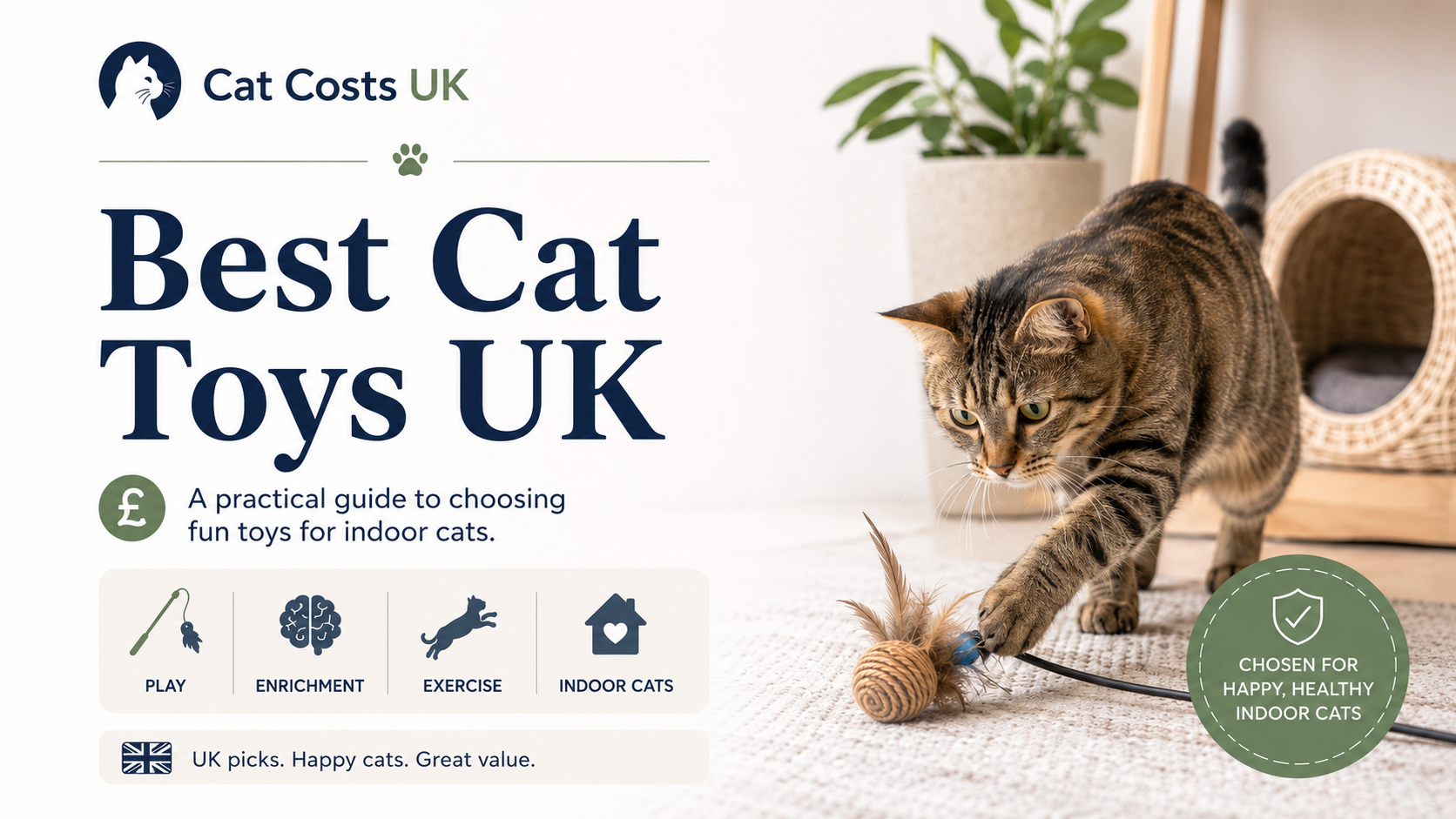
Cat toys help with play, exercise and enrichment, especially for indoor cats. The best toys are not always the most expensive; they are the ones your cat actually uses regularly and safely.
Best cat toys UK: quick answer
For most cats, the best toy mix includes an interactive wand toy, a few chase toys, a tunnel or hiding toy, and a puzzle or treat toy for variety. Rotate toys regularly so they stay interesting.
This guide compares cat toys by practical factors such as play style, safety, durability, supervision, indoor enrichment, storage, cleaning and whether the toy suits your cat’s age and confidence.
Unless stated otherwise, products have not been hands-on tested by Cat Costs UK. Always check current product details, safety notes, return policies and customer feedback before buying.
Best overall: interactive wand toys
Wand toys are one of the best starting points because they involve you in the play session. They can encourage chasing, pouncing and jumping, but should be put away after use if strings or feathers could be chewed.
Indoor cats often benefit from toys that add movement, hiding and thinking time. Cat tunnels, treat puzzles and rotating toy sets can help make the home feel more interesting.
Supervision: string and feather toys are best used with you present.
Durability: check toys regularly for damage.
Play style: some cats chase, some pounce, some prefer puzzles.
Rotation: put toys away and reintroduce them to keep interest.
Age: kittens may prefer different toys to older cats.
Value: mixed packs can help you learn preferences cheaply.
My recommendation
Start with a wand toy, a tunnel and a few small chase toys before buying expensive gadgets. Once you know your cat’s play style, add puzzle toys or interactive toys that match their behaviour.
Many cats enjoy wand toys, chase toys, tunnels and puzzle toys, but preferences vary by cat.
How many toys does a cat need?
A small rotating selection is usually better than lots of toys left out all the time.
Are laser toys good for cats?
Some cats enjoy them, but it can help to finish play with a physical toy they can catch. Avoid shining lasers near eyes.
Plan the wider cat setup
The product is only one part of the decision. Use the calculator to estimate the wider monthly budget, then browse the product hub for related essentials before you buy.
Affiliate disclosure: This article contains Amazon affiliate links. As an Amazon Associate, Cat Costs UK earns from qualifying purchases.
A good litter tray should be easy for your cat to use, easy for you to clean and large enough for your cat to turn around comfortably. The best choice depends on your cat’s size, age, mobility and whether litter tracking or odour is your biggest issue.
Best cat litter trays UK: quick answer
For most cats, the best litter tray is a large open tray with enough room to turn, dig and cover comfortably. High-sided trays can help with kicked litter, while covered boxes may suit some cats but are not accepted by all.
This guide compares cat litter trays by practical factors such as size, entry height, side height, cleaning, litter tracking, odour control, cat acceptance and whether an open or covered design suits your home.
Unless stated otherwise, products have not been hands-on tested by Cat Costs UK. Always check current product dimensions, cleaning instructions, return policies and customer feedback before buying.
Best overall: large open litter trays
A large open tray is usually the safest starting point because most cats understand and accept it. Choose a tray that gives your cat enough room to turn around rather than squeezing into the smallest option.
High-sided trays can help if your cat digs strongly or kicks litter over the edge. Make sure the entrance is still low enough for your cat to access comfortably.
Size: your cat should be able to turn and dig comfortably.
Entry height: lower entries help kittens and older cats.
Side height: higher sides can reduce kicked litter.
Cleaning: avoid awkward shapes that are hard to scoop.
Cat preference: some cats dislike covered boxes.
Placement: choose somewhere quiet and accessible.
Health changes: speak to a vet if your cat suddenly avoids the tray or changes toilet habits.
My recommendation
Start with a large open litter tray and add a litter mat. If kicked litter is the main issue, try a high-sided tray. Use covered boxes only if your cat is comfortable with enclosed spaces.
A large open tray is best for many cats because it is simple, accessible and easy to clean.
Are covered litter trays better?
They can help contain mess, but not every cat likes enclosed trays. Cat preference matters more than appearance.
How many litter trays do I need?
A common rule is one tray per cat plus one extra, but the right setup depends on your home and your cats.
Plan the wider cat setup
The product is only one part of the decision. Use the calculator to estimate the wider monthly budget, then browse the product hub for related essentials before you buy.
Affiliate disclosure: This article contains Amazon affiliate links. As an Amazon Associate, Cat Costs UK earns from qualifying purchases.
Plan your spend:Use the UK cat cost calculator to estimate the wider cost of caring for your cat before you choose a product or cover.
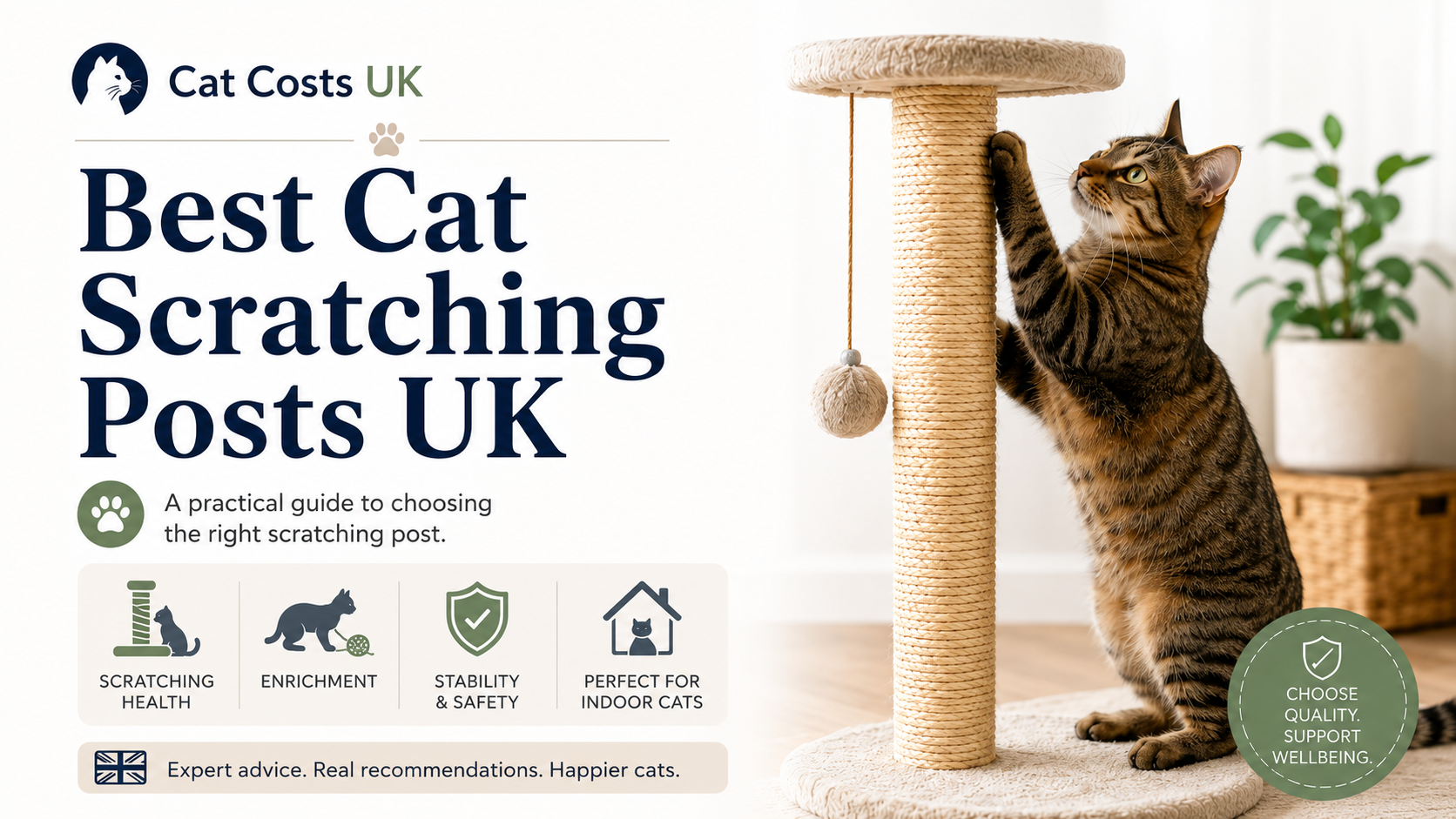
A scratching post is one of the most important cat products you can buy. Scratching is normal cat behaviour, so the goal is not to stop it. The goal is to give your cat something better to scratch than your sofa, carpet or door frame.
The best scratching post depends on how your cat likes to scratch. Some cats stretch upwards on tall posts. Others prefer horizontal cardboard scratchers. Many homes benefit from having more than one type.
For most cats, start with a tall, stable sisal scratching post. It should be high enough for your cat to stretch fully and sturdy enough that it does not wobble when used.
Placement matters. A good post hidden in a spare room may not get used. Put it where your cat already scratches or rests, such as near a sofa, hallway or favourite sleeping area.
Cardboard vs sisal scratchers
Sisal posts tend to last longer and suit cats who like vertical scratching. Cardboard scratchers are usually cheaper and can work well for cats who prefer horizontal scratching. Some cats like both.
What to check before buying
Height for a full stretch.
Stable base that does not wobble.
Scratch material your cat likes.
Whether your cat scratches vertically or horizontally.
Where it will sit in your home.
Replacement cost if it wears out.
My recommendation
Choose a tall sisal post first, then add a cardboard or horizontal scratcher if your cat still targets carpets or furniture. The best setup is usually practical rather than fancy.
Yes. Scratching is normal behaviour and cats need a suitable place to do it.
How tall should a scratching post be?
It should allow your cat to stretch comfortably. Taller posts are usually better for adult cats.
Why does my cat ignore the scratching post?
It may be too small, unstable, the wrong material, or placed somewhere your cat does not naturally use.
Last updated: 1 July 2026
Choose a scratching post that matches the behaviour
The best first purchase is usually the type your cat is already asking for. A cat stretching up a sofa arm is signalling for a tall, stable surface; a cat scratching carpet may prefer a horizontal cardboard or sisal scratcher. Placement often matters as much as the product itself.
When buying more than one makes sense
One post beside a favourite sleeping place and another near the problem furniture can be more useful than one expensive tower hidden in a corner. Start with a stable, appropriately sized option, then add a second shape if your cat still ignores it.
Before you build a larger cat setup, use the UK cat cost calculator to include replacement and ongoing costs in your budget.
If you are comparing a scratching post with other cat furniture, browse the cat products hub to compare related options before you buy.